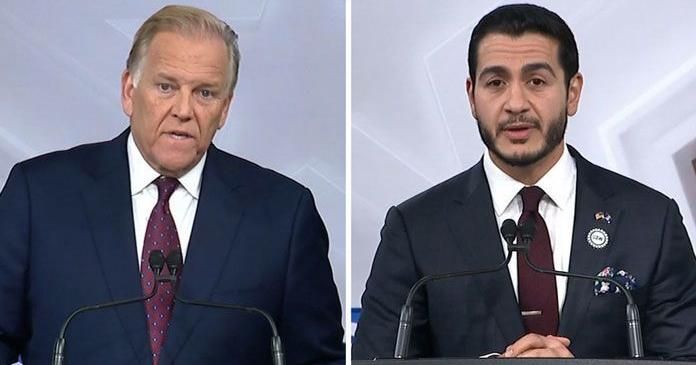
Rogers challenges El-Sayed's loyalty
In Michigan, Rogers accused El-Sayed of being bought off by the Muslim Brotherhood, an Islamist organization founded in Egypt, and alleged that some of his donors supported Iran-backed extremist groups, including Hamas and Hezbollah. El-Sayed has repudiated the Brotherhood.
The accusations followed President Donald Trump's false characterization of El-Sayed as a "jihadist." Born in Michigan, El-Sayed would become the first Muslim elected to the Senate if he wins.
"If you are going to go to the United States Senate, we need to know: Are you for America or are you for these terrorist groups overseas?" Rogers asked.
El-Sayed called the attack "shameful" and defended both his patriotism and religious freedom. "To bring into question my commitment to the Constitution is really beneath you," he said. "I am proud of America. I'm proud to be an American. I'm proud of our Constitution that guarantees all of us the right to pray as we choose to pray."
Rogers also challenged El-Sayed's credibility on policy, invoking a "pattern of deception" when discussing the Democrat's stated support for strong border enforcement. El-Sayed denied wanting to defund the police and accused Rogers of using Trump-style distractions. He repeatedly described his opponent's talking points as "MAGA bingo," adding: "When you are winning MAGA bingo, we are all losing."
Michigan's close contest tests both candidates
The candidates are competing to succeed retiring Democratic Sen. Gary Peters. With Republicans holding 53 Senate seats, Democrats need a net gain of four to win control. Michigan is one of just two states Trump won in 2024 where Democrats are defending a Senate seat.
A Marist Poll conducted October 15-18 among 1,185 likely voters put El-Sayed at 50% and Rogers at 48%, within its ±4.3-percentage-point margin of error. Among likely independent voters, El-Sayed led 50% to 44%. The RealClearPolitics polling average showed him ahead by about 2.6 points as of October 21, Newsweek reported.
Republicans have not won a Senate election in Michigan since 1994, but the state's recent results show how narrow the margins can be. Trump carried Michigan by about 1.5 points in 2024, while Democrat Elissa Slotkin defeated Rogers by roughly a third of a point.
Rogers, a former congressman, portrayed El-Sayed as too liberal for the state and appealed to Democrats dissatisfied with the primary result. He told supporters of defeated candidate Haley Stevens that they had a place in his campaign.
He also alleged that El-Sayed was "aligned" with the Democratic Socialists of America and favored "bigger government and more taxes." El-Sayed, the former executive director of the Detroit Health Department, identifies as a capitalist and does not belong to the DSA. Several DSA members support him, including New York Rep. Alexandria Ocasio-Cortez, who campaigned with him in the Upper Peninsula last week.
Trump's economy divides the Michigan rivals
El-Sayed worked to connect Rogers to the unpopular president, saying the two stood "hip to hip." Rogers acknowledged economic hardship in Michigan but argued that a Democratic Senate majority would make conditions worse.
Rogers said residents were "hurting," an assessment at odds with Trump's description of an economic "golden age." He defended some tariffs as a way to bring jobs back from Mexico and China, while criticizing the planning behind the trade war with Canada, a major concern for Michigan's border-state economy. He also argued that Democratic control of Congress would mean higher taxes and costs, including gasoline prices.
After Rogers complained that El-Sayed kept invoking Trump's name, the Democrat blamed the president's decision to go to war with Iran for worsening the cost of living. "Yes, I am going to blame Donald Trump because this is Donald Trump's economy. We are living in it," El-Sayed said.
Both parties planned high-profile campaign visits after the debate. According to Newsweek, Barack Obama was scheduled to appear with El-Sayed and gubernatorial candidate Jocelyn Benson in Detroit at 5 p.m. Saturday, October 24, the first day of early in-person voting. Trump was scheduled to hold a rally Sunday, October 25, at McMorran Place in Port Huron.
Hamilton rejects Schumer ties in Kansas
The Kansas debate was generally less combative, but Hamilton faced repeated attempts by Marshall to tie him to the Democratic leadership. Unlike El-Sayed, the Democratic pastor emphasized his disagreements with his party rather than making Trump the central target.
Trump won Kansas by 16 points, yet polling showed a toss-up Senate race less than two weeks before Election Day, according to NBC News. A Hamilton victory would make him the state's first Democratic senator in nearly a century.
Senate Minority Leader Chuck Schumer drew more mentions than Trump. NBC News counted 17 references to Schumer by Marshall during the hour-long debate as the Republican cast Hamilton as a supporter of the New York Democrat's agenda.
Hamilton has promised not to back Schumer for party leader if elected. "I've already said I wouldn't support Chuck Schumer for Senate majority leader if the Democrats were to control the Senate," he said.
Asked where he broke with Democrats, Hamilton described former President Joe Biden's border policies as a "disaster" and said he was "not somebody who favors the Socialist Party." He rejected Medicare for All and the Green New Deal, while saying he liked "parts" of the latter.
Marshall makes a direct appeal to Trump supporters
While Rogers criticized parts of Trump's trade policy in Michigan, Marshall largely defended the president's agenda. Asked about Trump's unpopularity even in Kansas, he urged the president's supporters to vote.
"I've had multiple times when I've objected to the president before, but I do want to emphasize: We need the Trump voters to come out," Marshall said. He appealed to voters who wanted Trump's agenda to continue, citing border security, military strength and lower taxes, and later said the president's "tariffs are working."
Trump had campaigned for Marshall at a rally near Wichita on Monday, October 19. A top Republican super PAC also launched $14 million in negative advertising against Hamilton, NBC News reported.
Marshall defended Trump's recent agreement with Russian President Vladimir Putin to lift sanctions on Russian diesel exports. He attributed high gas prices to the war in Ukraine, saying the conflict had reduced diesel production.
ICE raids and personal records draw scrutiny
Immigration enforcement brought some of the sharpest Kansas exchanges. Marshall described contacting Homeland Security Secretary Markwayne Mullin over ICE raids in southwest Kansas, presenting the call as an example of how he raises disagreements directly with the administration.
Marshall said he told Mullin: "Hey, I don't think this is quite right. What's going on?" He also suggested that a more secure border could allow a broader discussion of immigration reform and noted that, as a physician, he had delivered many babies to undocumented parents.
Hamilton challenged the contrast between that medical care and Marshall's support for deportation quotas. "With all of those undocumented children that you delivered, did you also call ICE and ask them to be taken away?" he asked. "You had compassion for them in delivering these children, but then you support quotas."
Hamilton also described a preschool teacher being arrested in front of her children in Hutchinson. "That's just not OK," he said, accusing the administration of militarizing and politicizing ICE rather than keeping its focus on protecting Americans from dangerous people.
Both candidates faced questions about their own records. Marshall denied reports that he had sued hundreds of patients over unpaid bills while practicing medicine, calling the allegations "blatant lies."
Asked about his church's handling of reports of child sex abuse, Hamilton denied approving the accused perpetrator's return to a church camp. But he acknowledged a failure to follow up: "I should have checked to make sure that he wasn't going back. That was a mistake on my part."