Pilot sets the mission, software executes it
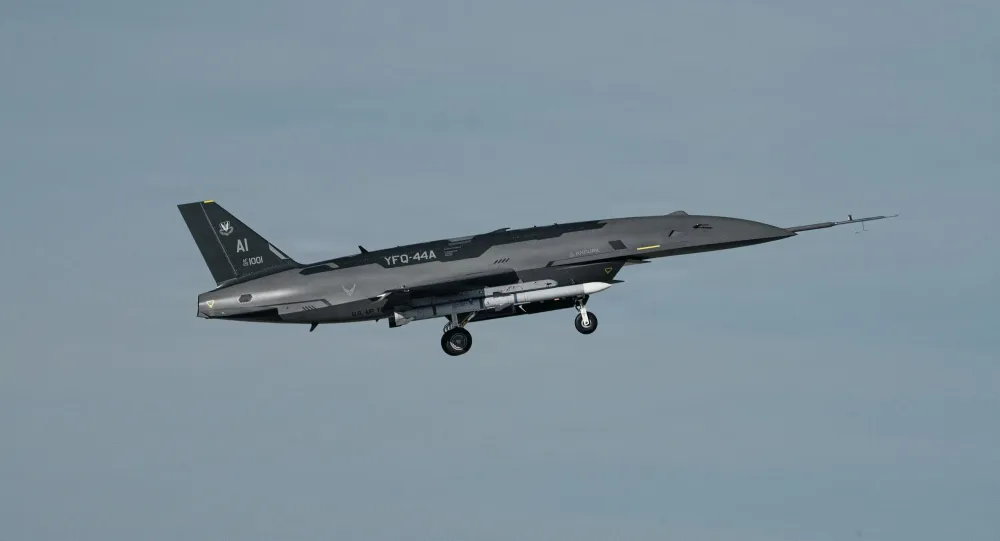
The demonstration lasted several hours during the week of October 5, Anduril told Air & Space Forces Magazine. According to an Anduril account reported by The War Zone, the two aircraft departed Edwards Air Force Base in California, met in the air and then tested the Raptor pilot's ability to update Fury's mission through a tactical data link.
The pilot supplied high-level direction rather than flying the drone through each maneuver. Its autonomy software "interpreted and executed those directives in real time, conducting dynamic flight maneuvers and simulated combat tasks," the Air Force said. Neither the service nor Anduril disclosed what equipment or configuration enabled the F-22 to transmit the instructions.
Only one Fury took part. The longer-term Air Force plan calls for a fighter pilot to direct several drones operating as a formation, Air & Space Forces Magazine reported.
Air Force Chief of Staff Gen. Ken Wilsbach described the test's significance in the service's release: "This flight shows the power of crewed-uncrewed teaming and the advantage it provides our warfighters." He added: "We must test often, learn fast and give commanders what they need, when they need it."
Anduril's vice president of autonomous airpower, Mark Shushnar, said the effort involves developing "trust between operators and their semi-autonomous wingmen."
What the first-flight claim covers
Anduril's claim applies specifically to the F-22 and pre-production YFQ-44A combination, not to every demonstration of a Raptor directing an uncrewed aircraft. General Atomics announced a similar test with an F-22 and an MQ-20 Avenger in November 2025, according to The War Zone. The Avenger has served as a surrogate for a Collaborative Combat Aircraft, or CCA.
Fury and General Atomics' FQ-42A Vengeance are the two aircraft the Air Force has ordered for the program's first phase.
The October test brought together personnel from six organizations: the 412th Test Wing, 422nd Test and Evaluation Squadron, 309th Software Engineering Group, Experimental Operations Unit, F-22 System Program Office, and CCA Software Autonomy and Teaming Branch.
Secretary of the Air Force Troy Meink linked the demonstration to cooperation with industry, saying in the release: "This achievement demonstrates what is possible when we are aligned with industry on a shared imperative: delivering capability to the warfighter at unprecedented speed."
Fury's flight and weapons milestones
The Air Force designated the prototype YFQ-44A on March 3, 2025. Its first flight followed on October 31 that year: a semi-autonomous sortie from Southern California Logistics Airport in Victorville. Anduril described the development effort as taking 556 days from a clean-sheet design to one-click takeoff.
A weapons test preceded the October teaming demonstration. On or about July 10, 2026, a YFQ-44A took off from Edwards and fired one live AIM-120 AMRAAM at a digital target over the Mojave Desert. The Air Force announced the event on July 15, identifying it as the first weapons employment by a US Collaborative Combat Aircraft.
On September 14, 2026, Meink announced the production aircraft's official name, FQ-44 Fury, alongside General Atomics' FQ-42 Vengeance.
The prototype has two underwing pylons. Anduril says the production FQ-44 will instead have four external weapons hardpoints, allowing it to carry four AIM-120 missiles. The CCA Increment 1 requirement specifies a combat radius exceeding 700 nautical miles, greater than that of either an F-22 or an F-35.
Aircraft specifications remain indicative
Fury is a single-engine, jet-powered CCA roughly half the physical size of an F-16. Published specifications inherited from the earlier Blue Force Technologies Fury design describe an aircraft about 20 feet (6.1 meters) long, with a wingspan of 17 feet (5.2 meters) and a maximum gross weight of approximately 5,000 pounds.
Those legacy specifications list a Williams International FJ44-4M turbofan in the roughly 4,000-pound-thrust class, a maximum speed near Mach 0.95 and a service ceiling around 50,000 feet. They also give load limits of up to +9 G transient and about +4.5 G sustained. These are indicative figures for the earlier design, not confirmed specifications for the production aircraft.
Production orders, costs and fleet targets
The Air Force awarded Anduril and General Atomics engineering-and-manufacturing-development and production contracts for CCA Increment 1 on June 17, 2026, four months ahead of schedule. Covering the first three production lots of the FQ-44 and FQ-42, the awards are intended to support fielding at least 150 systems by the end of the decade. The service's broader targets are 500 combat-ready, semi-autonomous systems by 2032 and an eventual fleet of 1,000.
Anduril had begun production work in March 2026 at Arsenal-1 in Pickaway County, Ohio. The plant's first Ohio-built Fury rolled out on July 27. The company says the facility's current configuration can produce up to 150 Fury airframes annually, exceeding the volume required by existing Air Force orders.
Air Force officials cited a cost target of about $20 million per bare CCA airframe in 2026. The earlier planning objective, set in 2023, was around $30 million, or roughly one-third of an F-35's flyaway cost. Officials say the program is beating those earlier projections, while Anduril says Fury would cost well below $20 million per aircraft at the quantities currently contemplated.
For fiscal 2027, the Air Force has requested its first CCA procurement funding: about $996.5 million, along with roughly $150 million in advance procurement for 2028. The request also includes approximately $1.37 billion for research and development, putting the program total near $2.4 billion.