An early visitor, but not yet a complete route
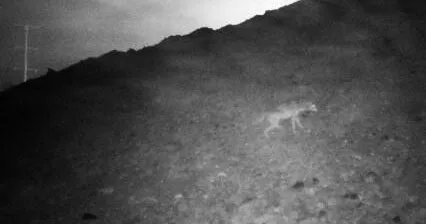
The photo, released Wednesday, shows the coyote ascending the crossing's southern slope. It could not travel the full route: As of early November, crews had not yet added enough soil to connect the project's two overpasses, according to the Los Angeles Times.
One overpass spans the freeway and the other crosses Agoura Road. A graded slope will link them, and crews were rapidly adding soil to close the gap, the Times reported.
The coyote was not the first wildlife spotted on the structure. Wildlife Crossing Fund president Beth Pratt told the Times that smaller animals, including the Western fence lizard, had appeared there earlier. National Park Service scientists monitoring construction also reported regular use of a trail immediately beside the future crossing by bobcats, coyotes, gray foxes, mule deer and mountain lions.
At Liberty Canyon Road, the 165-foot-wide crossing stretches across 10 freeway lanes. It is reserved for wildlife, not human use. Project leaders describe the planned habitat as serving animals ranging from mountain lions, bobcats and deer to desert cottontails, lizards, bats, monarch butterflies and dozens of bird species.
Measuring movement, genetics and stress
Cameras are one component of a monitoring program designed by National Park Service biologists, project partners and other researchers. The eventual network will include more than 50 still-photo cameras and four thermal video cameras, park wildlife biologist Jeff Sikich told the Los Angeles Times. The public will be able to see images and footage, but not through a live feed.
Researchers will also use GPS radio tracking to follow mountain lions, bobcats, coyotes, deer and gray foxes. To assess physiological stress, scientists are implanting devices called biologgers in deer, with mountain lions to follow soon. Those devices will record body temperature, heart rate and fat reserves, the Times reported.
"This is more than just about whether animals use the crossing," said Seth Riley, the wildlife branch lead at Santa Monica Mountains National Recreation Area. "We want to understand how effective it is in reconnecting an ecosystem that has been divided by the freeway for decades. That is a much bigger scientific question and answering it will take years."
The effort builds on park biologists' research in the Santa Monica Mountains region dating to 1996. According to the National Park Service, their studies of habitat fragmentation documented the effects of freeways and urban development on wildlife movement and gene flow, supplying the scientific basis for the crossing.
For the Santa Monica Mountains' mountain lions, genetic diversity is already critically low because close relatives have been mating, the Times reported. Signs of inbreeding include kinked tails and deformed testicles. Sikich said a single mountain lion entering the Santa Monicas and breeding could make a meaningful difference.
Construction and the December opening
Construction began in 2022, with completion scheduled for December. Caltrans divides the work into two stages. The first covered the vegetated bridge over US-101 and supporting roadway work within the agency's right of way; it ran from mid-2022 through June 2025.
The second stage began in 2025 and is scheduled for completion in 2026. It includes the vegetated crossing over Agoura Road, utility relocation, earthwork and restoration of nearby wildlife habitat.
The crossing is scheduled to officially open to wildlife on Dec. 2, 2026. Organizers have also announced a community festival that day at King Gillette Ranch in Calabasas, according to LAist. The event will run from 11:30 a.m. to 3:30 p.m., with exhibits, music and special guests. Tickets cost $5 for children 12 and under and $10 for everyone else. A ribbon-cutting ceremony at the crossing will be broadcast live to the public.