Boat team assesses injuries
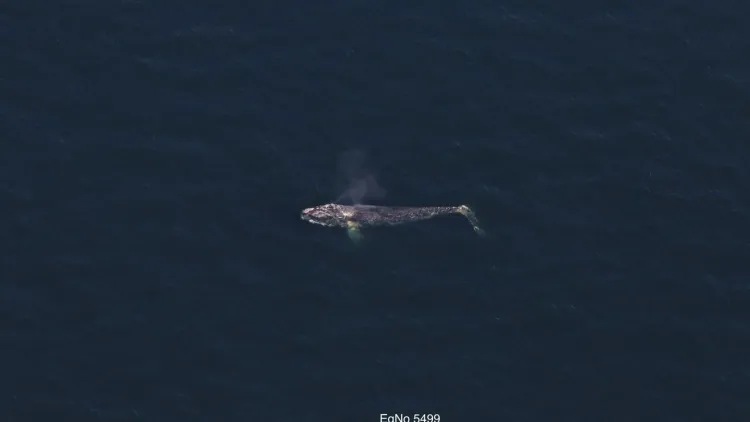
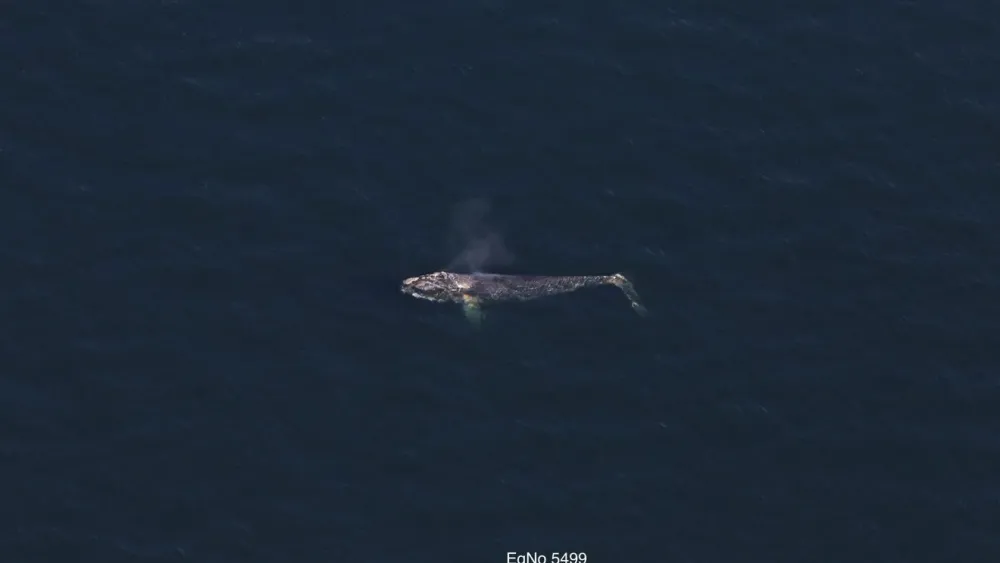
A public report brought Center for Coastal Studies aerial observers to waters off Provincetown, where they located the whale. Observer Ryan Schosberg described its poor body condition and wounds consistent with a recent entanglement.
With gear potentially still attached, the center sent its Marine Animal Entanglement Response team, known as MAER, to investigate by boat. Responders collected a biopsy using a crossbow and lowered a camera beneath the surface to examine the animal.
"The underwater footage showed that the whale was no longer entangled but was suffering from the effects of a long-term entanglement," said Scott Landry, director of the center's MAER program.
NOAA has not yet issued an assessment of whether #5499 is likely to survive. The New England Aquarium's right whale catalog records a Feb. 28, 2026, sighting when the animal was in better health, placing the entanglement sometime since March.
An unusual Atlantic crossing
Whale #5499 was already notable for where researchers first encountered it. Most right whales enter the sighting record as calves along the U.S. coast; this animal was first documented as an adult in Donegal Bay, Ireland, in July 2024.
It later crossed 3,000 miles of the Atlantic and was seen off Cape Cod. Its first documented western North Atlantic sighting came on Nov. 19, 2025, when Center for Coastal Studies aerial observers found it roughly 23 nautical miles east of Boston.
The New England Aquarium and the center identified that encounter as the first documented case of a right whale initially recorded in the eastern North Atlantic and subsequently seen in the western North Atlantic.
Healthy pair spotted during expanded surveys
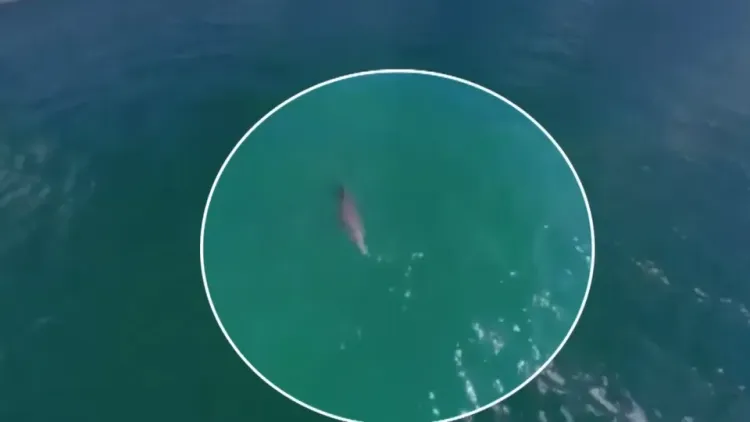
Elsewhere on the Oct. 25 survey, observers found right whale #3780, known as "Bermuda," and her calf southeast of Chatham. Both appeared healthy. The pair had not been seen since April, when they were in Cape Cod Bay.
Schosberg said the calf, estimated to be 11 months old, was already feeding independently and nearing weaning. Calves can remain with their mothers for up to a year as they learn to feed, so this could be one of the last chances to observe the two together. He noted that many calves seen in spring are not spotted again until the following year or later, after weaning.
NOAA Fisheries says Bermuda is at least 19 years old and this is her second known calf. She first gave birth in 2024, but observers saw her without that calf shortly afterward. The agency notes that two-year intervals between births have been documented only among females whose calves died on the calving grounds.
The October observations came ahead of the center's usual December start for aerial right whale surveys, when more whales return to Cape Cod Bay. The center said government funding for an expanded fall schedule was cut last year, but increased support from the Massachusetts Division of Marine Fisheries allowed an earlier start this year.
Dr. Daniel Palacios, director of the center's Right Whale Ecology Program, said the additional flights help researchers detect whales earlier in state and nearby waters, track changes in their distribution and inform management decisions.
Entanglements remain a major threat
Ropes used in crab and lobster fishing can entangle right whales, and entanglement has been their leading cause of death in recent years. Nearly all recent deaths and injuries have resulted from human activity, through either fishing-gear entanglements or vessel strikes. NOAA Fisheries and its partners estimate that more than 85 percent of North Atlantic right whales have experienced at least one fishing-gear entanglement.
An Unusual Mortality Event has been underway since 2017, reflecting an unusual number of injured or dying whales. As of 2026, NOAA Fisheries has documented impacts to 176 individual whales, including deaths, serious injuries and sublethal injuries or illness.
Within that period, at least 46 right whales have been confirmed dead or observed with serious injuries caused by entanglement. NOAA Fisheries estimates that the actual number is likely closer to 100 because many deaths are never observed. More broadly, the agency says research indicates that only about one-third of right whale deaths are documented.
The population nevertheless shows some signs of increasing. NOAA Fisheries' latest estimate is approximately 380 whales, about 20 more than in 2020, marking a third consecutive year of signs of growth. Only about 70 females are reproductively active.
Researchers also identified 23 calves during the 2026 calving season, according to NOAA Fisheries, which described it as the highest calf count in 17 years.
Protection rules and reporting entanglements
Massachusetts requires commercial fixed-gear fisheries to remove gear during winter and spring when right whales are present, according to Mass.gov. Those fisheries must also use buoy lines with a breaking strength below 1,700 pounds. Seasonal vessel speed limits of 10 knots or less apply in certain habitats, including Cape Cod Bay.
Right whales are federally protected. Boats, drones, kayakers and paddleboarders must remain at least 500 yards away. Boaters are also urged to slow down and watch for whales, which can sometimes be viewed from Cape Cod beaches. Disentanglement work is conducted under a federal research permit authorized by NOAA.
The Center for Coastal Studies asks boaters who see an entangled whale, sea turtle or other marine animal to contact MAER at 1-800-900-3622 or the U.S. Coast Guard on VHF Channel 16. Boaters should remain nearby at a safe distance until trained responders arrive.