Stevens explains her break
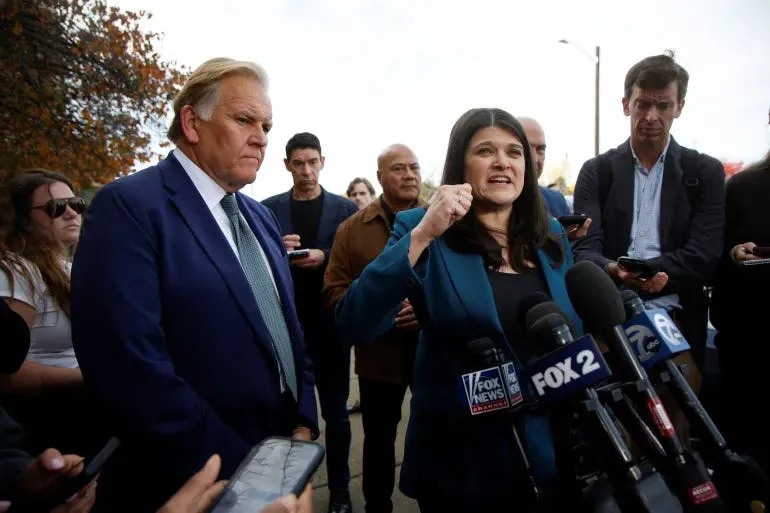
In her endorsement video, Stevens said El-Sayed's campaign had told her she was no longer welcome and should stay away. "I do not belong in Abdul's campaign," she said, adding: "that's why I am endorsing Mike Rogers for the United States Senate today."
Rep. Debbie Dingell offered an account of the canceled joint church appearance planned for Nov. 1. Dingell, who helped organize it, said she had asked Stevens not to attend because the event "had become way too distracting." Stevens agreed to stay away, Dingell said, according to PBS NewsHour and The Associated Press.
The rupture followed a costly and unexpectedly close Democratic primary. Several polls had put El-Sayed ahead by double digits, but he defeated Stevens in August by less than 1 percentage point. Stevens took more than 60% of Detroit's vote; El-Sayed became the first Michigan Democrat since 2018 to win a statewide primary without carrying the state's largest city.
Outside groups spent tens of millions of dollars on the primary. Among them was the American Israel Public Affairs Committee's affiliated super PAC, which supported Stevens.
A competitive race for a pivotal seat
El-Sayed, 42, supports Medicare for All and ending U.S. military aid to Israel. The progressive Democrat would be the first Muslim U.S. senator if elected. Rogers, 63, is a former congressman who narrowly lost Michigan's 2024 Senate race to Democrat Elissa Slotkin. He has since departed from President Trump's positions on two issues, urging an end to the "tariff war" with Canada and saying the Iran conflict should "end quickly."
They are competing for the seat held by retiring Democratic Sen. Gary Peters. Republicans control the Senate 53-47; the Democratic total includes two independents who caucus with the party. Democrats need 51 seats to regain control, making a Michigan win central to their prospects. The state's recent presidential results reflect its close partisan divide: Trump won in 2016, Joe Biden in 2020 and Trump again in 2024, all by slim margins.
October polling generally favored El-Sayed. According to Yahoo News, 11 of the month's 12 polls gave him leads of 1 to 7 percentage points. The only recent survey putting Rogers ahead, by 2 points, was sponsored by a group affiliated with him.
Writing Sunday in The @smotus Report, Masket cited a 4.6-point El-Sayed lead in the DecisionDesk polling average and a 71% chance of victory from FiftyPlusOne. He nevertheless cautioned that polling error remained possible after a fall in which the contest had stayed fairly close.
Masket also raised the possibility that another Democratic nominee might be doing better. In his assessment, El-Sayed could face resistance because he is a person of color, Muslim or progressive, or because voters associate his racial and religious identity with progressive politics. That possibility, Masket argued, is distinct from whether Stevens can persuade additional voters to oppose him this late.
Familiar attacks and a Democratic backlash
Masket's case for a limited electoral effect starts with the familiarity of the criticism. Stevens attacked El-Sayed during the primary, while Rogers has spent four months making similar arguments. Conservative figures in Michigan and nationally have also amplified them. Trump called El-Sayed a "jihadist" who would take away Christmas; Vice President JD Vance described him as an anti-white racist who would bring widespread social unrest to the United States.
Stevens' history as a lifelong Democrat might give those accusations added credibility, Masket acknowledged. But he saw the response to her endorsement as largely confined to praise from the Rogers campaign and the White House. Trump welcomed her comments and invited her to join the Republican Party, a response Masket doubts will help her with Democrats or Michigan independents.
Democratic leaders instead moved to distance themselves from Stevens. Democratic National Committee Chair Ken Martin and Senate Minority Leader Chuck Schumer condemned the endorsement; Schumer called it a "despicable betrayal." Much of Stevens' congressional staff quit, and Black Michigan Democrats criticized her choice of a Black church as the setting for her announcement.
Masket expects the break to jeopardize Stevens' relationship with the Democratic Party. He also points to two practical limits on its reach: roughly 2 million Michigan residents have already voted, out of an expected electorate of around 4 million, and only a small share of voters are likely both to hear a Sunday endorsement and change their Senate choice because of it.
The comparison behind Masket's assessment
Masket draws a parallel with New York City's 2025 mayoral election. After losing the Democratic primary to Zohran Mamdani, Andrew Cuomo continued challenging him in the general election. Masket describes Cuomo's effort as an appeal by a more establishment-friendly Democrat against a progressive Muslim man of color, emphasizing Mamdani's position on Israel and portraying him as an outsider.
Masket sees little evidence that those attacks damaged Mamdani's support. His polling improved over the summer, settled in the mid-40s during the fall and ultimately understated his Election Day result: Mamdani won 51% of the vote.
Michigan's 2026 electorate differs substantially from New York City's in 2025, Masket acknowledges. His comparison concerns whether renewed attacks expand opposition to a candidate when voters have already heard the underlying arguments, not whether the two electorates are interchangeable.
Late polling could still register a shift, Masket wrote, and Tuesday's returns will show whether El-Sayed finishes above or below his current polling. His prediction is that Stevens' endorsement will alter her own political future more than El-Sayed's result.