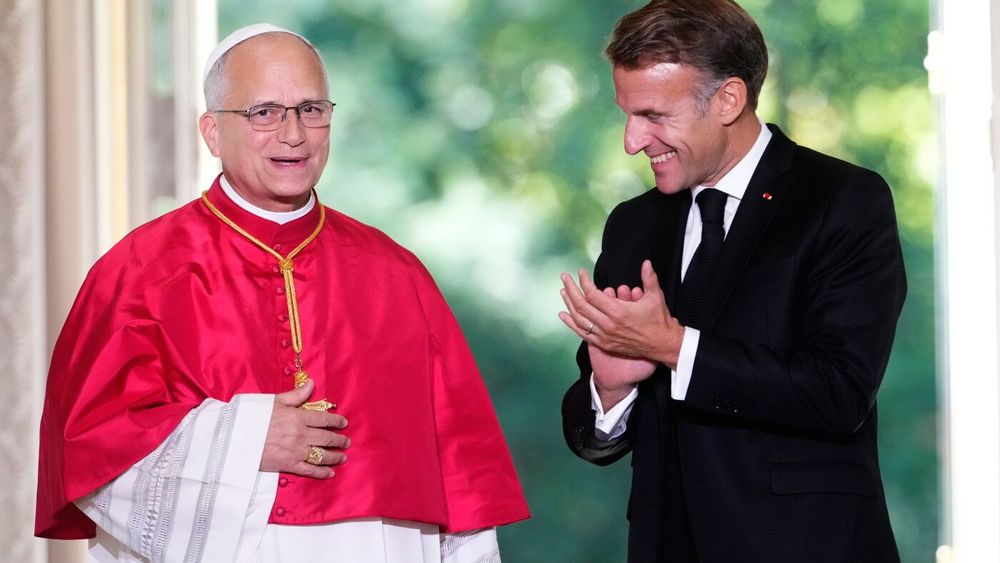
Pope Leo XIV warns of 'paradise of machines' threatening humanity during historic France visit
Pope Leo XIV issued a sobering warning Friday that humanity risks being undermined by a "paradise of machines," opening his visit to France with fundamental questions about what it means to be human in an era defined by artificial intelligence, nuclear proliferation, and mounting threats to human life.
The first American pope in Catholic Church history, elected in late 2024 following the death of Pope Francis, addressed existential concerns about scientific progress during speeches at the Élysée Palace and UNESCO headquarters in Paris. With wars raging in Europe and the Middle East, Leo reaffirmed Vatican opposition to nuclear weapons and declared the nuclear deterrence doctrine "mistaken" for fueling a new arms race.
Peace is not a balance of power; rather, it is built day by day through dialogue and justice
he told diplomats and United Nations officials at UNESCO, the UN's leading forum on education, science, and cultural issues with 194 member states.
The four-day visit marks the first full papal state visit to France since Pope Benedict XVI traveled there in September 2008. Thousands lined Leo's motorcade route despite unseasonable heat, waving French and Holy See flags in a turnout that surprised observers given France's increasingly secular character.
Challenging terrain for Catholic teaching
Leo faces a particularly difficult environment for advancing church doctrine in France, where approximately 51% of citizens now identify as having no religion and only 29% identify as Catholic—a dramatic decline from over 80% in the 1960s. The strict separation of church and state, established by France's 1905 law on laïcité, makes it one of Europe's most secular governance frameworks, prohibiting government recognition or funding of religions.
The challenge intensified when France became the first country in the world to explicitly enshrine abortion rights in its constitution in March 2024. More recently, French lawmakers approved legislation allowing adults with incurable illnesses to receive lethal medication, prompting the Vatican's Dicastery for the Doctrine of the Faith to issue statements reaffirming that euthanasia and assisted suicide are "intrinsically evil" under Catholic teaching.
In his address to President Emmanuel Macron and government authorities, Leo reminded France of its "deep Christian roots" and emphasized that the right to life is the "indispensable foundation of every other human right."
AI and the crisis of human dignity
The pope's most urgent warnings centered on artificial intelligence and its implications for human dignity.
The paradox has become increasingly evident: while 'intelligence' is attributed to computational systems, we struggle to recognize the inalienable dignity of human persons, whose lives are judged according to the criterion of efficiency and, when deemed no longer productive, are rejected and discarded
he said.
Leo has made AI regulation a cornerstone of his papacy, dedicating his first encyclical, "Magnificent Humanity," to the topic and calling for robust oversight to ensure AI serves the common good rather than profit. His appeals appear to be resonating: several major AI companies, including OpenAI and Anthropic, announced voluntary slowdowns or extended safety review periods in 2026, citing concerns about AI safety and alignment with human values.
If we are to avoid losing our humanity amid a 'paradise of machines' invading and conditioning our daily lives, there is an urgent need for education in ethical discernment and the capacity to acknowledge the moral good
Leo told the gathered diplomats and officials.
Speaking to reporters, the pope expressed satisfaction that his message was being heard. "Many of them are very much open to looking for ways of making sure that AI does not displace or ultimately destroy humanity, but rather is a tool for human beings," he said.
Political significance for Macron
For Macron, who is barred from seeking a third term in elections scheduled for May, hosting the American pope represents something of a capstone achievement. The French president's approval ratings stand at approximately 23-26%—near the lowest levels of his presidency—driven by public anger over rising living costs, pension reforms, and deteriorating public services.
"For a president of the republic as Macron, who is at the end of his mandate, it can be important to be aside the pope and to capture a part of his popularity," said Charles Mercier, director of history and sociology of Catholicism studies at Paris EPHE university.
Smiling broadly as Leo spoke French, Macron thanked the pontiff for the extended visit, saying: "You are here with us for an extended visit, giving us your time, and that is moving."
Historic return to Notre Dame
Friday evening brought Leo to Notre Dame cathedral for the first papal celebration there since the devastating 2019 fire consumed the cathedral's roof and toppled its spire. After being mobbed by enthusiastic nuns outside, Leo walked down the central aisle to thundering organ music and cheers from the pews.
The restoration required over 1,000 artisans and craftspeople working for five years at an estimated cost of €700 million (approximately $750 million). As bells tolled, Leo knelt in silent prayer at the same spot where flames had brought down scorched roof beams seven years earlier.
The pope marveled at the brilliance of the restored stained-glass windows and cream columns, praising the artisans and urging priests and nuns gathered in the pews to be inspired by the collective effort that brought the Gothic masterpiece back to life.
"To see him, praying with us, it comforts us in our faith and on our path," said Senegalese Sister Antonia Faye, glowing after her first papal event. "Being with the pope is different to being alone or praying alone. We felt the benediction that came down on us."