Chicago Sky partners with national security experts to combat player threats
The Chicago Sky has taken an unprecedented step in professional sports by partnering with national security experts to protect its players from a surge of threats and abuse that has accompanied the WNBA's explosive growth in popularity.
The franchise has enlisted American University's Polarization and Extremism Research and Innovation Lab (PERIL) and threat intelligence firm Moonshot to monitor and counter harassment targeting its athletes. The Sky is the first WNBA team to implement such measures, according to team chairman and co-owner Nadia Rawlinson.
"When our players were telling us this is what they're seeing, I believed them because it was very much related to how I experience my own life," said Rawlinson, who drew on her experience as an African-American woman executive in corporate America to understand the challenges her players face.
The 2024 WNBA season shattered records with more than 54 million unique viewers across broadcast networks and total attendance of 2,353,735 fans—the highest in 22 years and a 48% increase from 2023. The season saw 154 sellout games, a 242% jump from the previous year's 45 sellouts. The Indiana Fever alone drew 340,715 fans to home games, breaking a single-season attendance record that had stood since 2001.
But alongside this unprecedented success came a darker trend. Players across the league have reported being inundated with targeted abuse, harassment and threats both online and offline. The problem intensified during the 2024 season, which featured highly publicized rookies Caitlin Clark of the Indiana Fever and Angel Reese, then with the Chicago Sky.
In July 2025, a 55-year-old Texas man named Michael Lewis was sentenced to 2.5 years in prison for stalking Clark. He had sent over 800 threatening and sexually explicit messages and traveled from Texas to Indianapolis with tickets to sit behind the Fever bench. Clark told police she was "very fearful" and had altered her public appearances due to safety concerns.
Reese has been one of the most targeted players in the league. She publicly disclosed in April 2024 that she had been receiving death threats, sexualized abuse and harassment since winning the NCAA championship in 2023. AI-generated nude images of her were later created and sent to her family members.
Misogyny as a gateway to violence
Cynthia Miller-Idriss, founder of PERIL and author of the book Man Up: The New Misogyny & The Rise of Violent Extremism, argues that misogyny is a common thread linking various forms of violence, from gang activity to mass shootings.
"It is one of the biggest common denominators in gang violence, in stalking harassment of athletes, in gender disinformation campaigns against politicians, and in school shootings and other acts of mass violence, terrorism and targeted violence," Miller-Idriss said.
Research analyzing mass shootings between 2014 and 2019 found that in 68% of incidents, the perpetrator either killed an intimate partner or family member, or had a history of domestic violence. These shootings also had higher fatality rates than those without domestic violence connections.
Miller-Idriss described misogyny as "a Trojan horse that carries all these other forms of anti-immigration, anti-Muslim ideas [and] anti-Semitic ideas." PERIL's partnership with the Chicago Sky includes launching a campaign called "Be the Sixth Player," which provides educational materials to help fans intervene when they witness misogynistic rhetoric or social media posts targeting people in the sport.
Technology-enabled threats and racial dynamics
Elizabeth Neumann, chief strategy officer at Moonshot, noted that the company's threat monitoring tools were originally developed for governments to counter terrorism. "It says a lot that here we are, 10 years later, taking that same technology, the methodologies that we use to help governments counter terrorism and other targeted violence, and we are now having to apply it to sports entertainment," she said.
Michael Pattullo, head of insights for Moonshot's U.S. office, said data shows that abuse aimed at Black women athletes is "frequently both racialized and sexualized at higher rates than what we see for their white teammates facing similar visibility." Ninety percent of threats monitored by Moonshot targeted women athletes, and 80% targeted people of color.
The 2024 season saw particularly strong growth among diverse audiences, with viewership among Hispanic and Black fans growing 96% and 67% year-over-year respectively. Young girls tuning in increased by 139%.
"When threats are directed at men, they skew more toward performance-based hostility, whereas for women, the abuse is disproportionately about their identity, their gender, their appearance, their sexuality," Pattullo said. "Performance has very little to do with the threats that they receive."
Bad-faith provocations
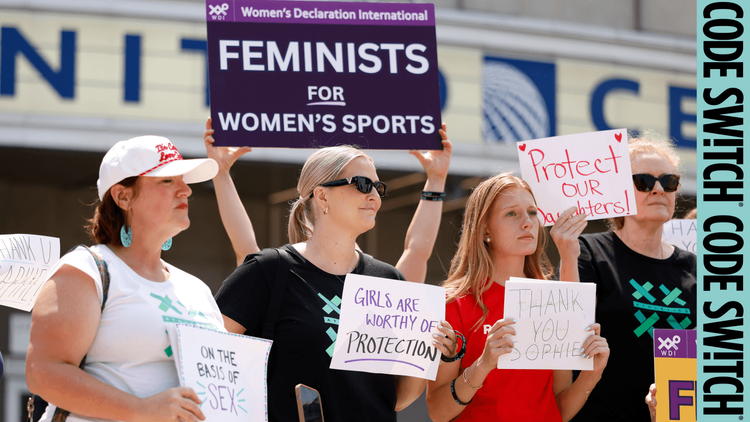
Recent weeks have seen deliberate provocations at WNBA games. Sex toys were thrown onto courts at games in Chicago and Los Angeles, and a former NBA player who has used the league as a platform for anti-trans advocacy was ejected from a Chicago Sky game after an altercation with guard Natasha Cloud.
These incidents relate to controversy around the eligibility of transgender women to play in the league. The WNBA's 2026 collective bargaining agreement states that "only players who are women are eligible to play in the WNBA," but does not define the term "woman" or include explicit policies governing transgender or intersex athlete eligibility. The league has never had transgender women players.
Independent journalist Frankie de la Cretaz, who covers the intersection of sports and gender, said the characteristics that made the WNBA inclusive and diverse are now reasons the league faces attacks. "Almost all of [the players] are multiply marginalized, which means that they have more than one identity that they can face oppression and marginalization over," de la Cretaz said.
A broader pattern
The threats facing WNBA players are part of a larger trend. Moonshot's monitoring of Team USA athletes revealed that between the Paris 2024 Olympics and the Milano-Cortina 2026 games, threats of violence per athlete increased sevenfold, non-consensual intimate imagery increased fivefold, and credible threats escalated to law enforcement doubled.
Neumann attributed the deteriorating environment partly to technological changes that make it easier for bad actors to generate fake nude images and post personal addresses, as well as social media platforms becoming less responsive to content removal requests. But she also pointed to broader cultural shifts.
"There's a bit of a cultural moment that we're finding ourselves in where misogyny is on the rise," Neumann said.
For Rawlinson, the protective measures are a business decision aimed at allowing her players to focus on their performance. "I just want my players to think about their one mission, which is to be the most competitive, best player that they can when they come out to the court every night for a game," she said.