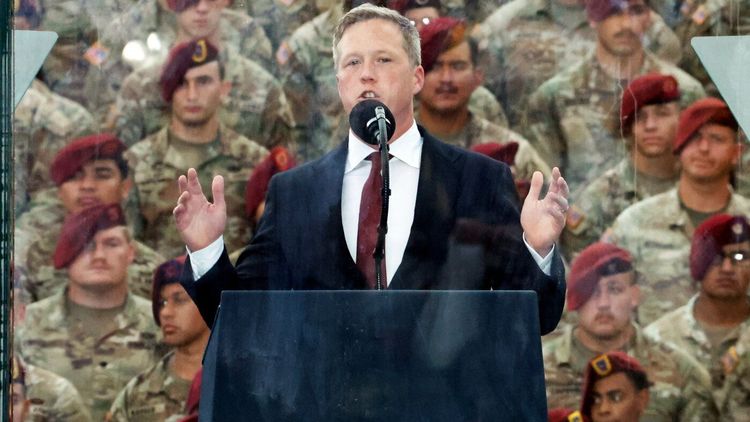
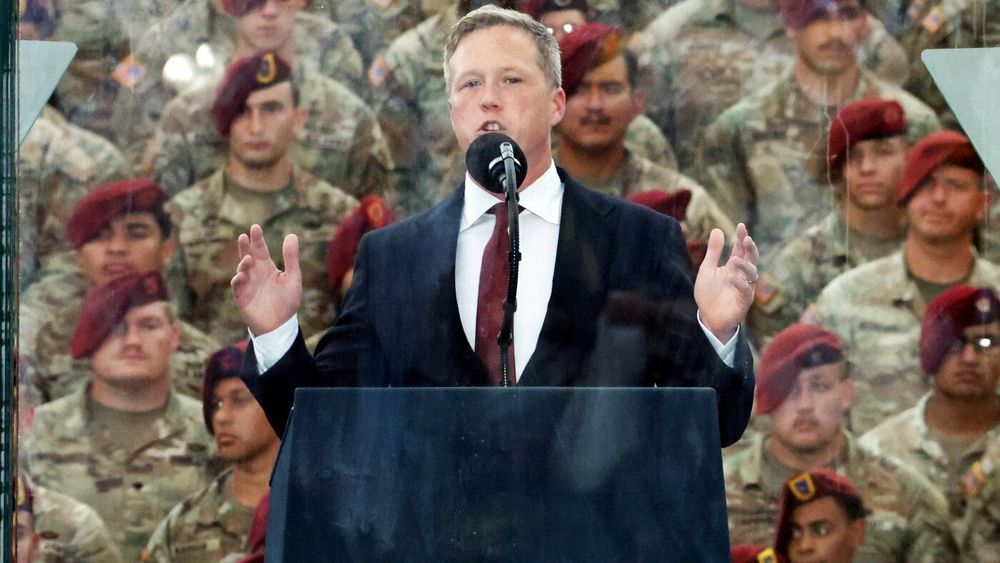
Army Secretary Dan Driscoll resigns after 18 months amid Pentagon leadership upheaval
Army Secretary Dan Driscoll has resigned after 18 months in office, the White House announced Monday, marking another departure in the ongoing reshuffling of military leadership under the Trump administration.
The White House did not provide a specific reason for the resignation, though tensions between Driscoll and Defense Secretary Pete Hegseth have been widely reported. White House spokeswoman Anna Kelly praised Driscoll's work in a statement, saying he had been "highly effective in advancing President Trump's agenda to Make America Strong Again."
Driscoll, who at 38 became the youngest person ever to hold the position of Army Secretary when sworn in during March 2025, leaves after a tenure marked by his advocacy for military modernization and his unusual role as a key negotiator in efforts to end the war between Russia and Ukraine.
An Army official, speaking on condition of anonymity, said Driscoll discussed the current state of the Army with President Donald Trump before submitting his resignation. The official did not elaborate on the circumstances surrounding the departure.
Military background and private sector experience
A graduate of the University of North Carolina at Chapel Hill with a degree in Business Administration and Yale Law School with a law degree, Driscoll brought both military and business credentials to the role. He served as a cavalry officer in the 10th Mountain Division at Fort Drum, New York, leading a cavalry platoon during deployment to Baghdad in 2009 as part of Operation Iraqi Freedom. His military service, which lasted from August 2007 to March 2011, earned him the Army Commendation Medal, Ranger Tab, and Combat Action Badge.
Between his military service and government appointment, Driscoll worked in the private sector, serving as Chief Operating Officer of a $200 million venture capital fund and holding leadership roles in investment banking and private equity. He met Vice President JD Vance at Yale Law School, later serving as an adviser to Vance. When Trump nominated him in 2024, the president called Driscoll "a disruptor and change agent."
The Senate confirmed Driscoll in February 2025 by a vote of 66-28, following a largely uncontroversial Armed Services Committee hearing focused on Army modernization, recruiting improvements, and strengthening the military industrial base.
Tensions over Army leadership changes
Driscoll's departure follows the removal of one of his close allies and the cancellation of a drone program he had championed. In April, Hegseth abruptly ousted Gen. Randy George, the Army's top uniformed leader who had been nominated by President Joe Biden and confirmed by the Senate in 2023. Under the standard four-year term, George would have typically served until 2027.
Gen. Christopher LaNeve, who previously served as Hegseth's senior military assistant at the Pentagon before becoming Army vice chief of staff in February 2026, replaced George as acting chief of staff. LaNeve, who commanded the 82nd Airborne Division at Fort Bragg in North Carolina before serving as a three-star general heading the Eighth Army in South Korea, has made a rapid rise under Hegseth's leadership.
Under LaNeve's direction, the Army discontinued a drone modernization program. An Army unit based in Europe that had been building its own drones was directed to end its efforts and return to traditional infantry battalion operations, officials said in August.
Driscoll publicly lamented George's departure. He told Congress in April that he and his family drove to George's house following the resignation "and we all gave him a hug." However, he acknowledged that "the civilian leadership, the design of our system, is that they get to pick the leaders that they want."
Gen. Christopher Donahue, the Army's commander in Europe and Africa, unexpectedly stepped down in June, adding to the leadership turbulence within the service.
Broader pattern of military leadership departures
Driscoll's resignation is part of a broader pattern of high-level military departures during Trump's second term. More than a dozen generals and admirals have been fired, with others retiring early since Hegseth became defense secretary in January 2025.
Navy Secretary John Phelan left his position in April 2026, becoming the first head of a military service to depart during this administration. Phelan, who had been confirmed with bipartisan support by a vote of 62-30 in March 2025, served just over one year in the role.
Congressional reaction
Lawmakers from both parties responded to the news with praise for Driscoll's service. Rep. Steve Womack, an Arkansas Republican and former Army National Guard member, called Driscoll "a transformative leader who brought common sense and discipline to the Department of the Army" on social media.
Rep. Jason Crow, a Colorado Democrat and former Army Ranger, told reporters he worked well with Driscoll despite policy differences. "It was actually nice, I will say, having somebody who was smart, that knew the policy, that wanted to do the work, that had a background in these issues," Crow said, adding that "it's unfortunate that somebody like that can't last in this administration."
Crow, who serves on the House Armed Services Committee and co-chairs the House Army Caucus, expressed concern about the impact of leadership changes. "The Pentagon right now is, in some cases, rudderless," he said. "So, I'm gravely concerned about it."
Rhode Island Sen. Jack Reed, the ranking Democrat on the Senate Armed Services Committee and a former Army officer, said Driscoll "worked to transform the Army for the battlefield of the future, and he engaged with Congress candidly and consistently." Reed criticized the broader trend, stating that "Secretary Hegseth is cultivating a culture where dissent is punished and competence is secondary to personal allegiance," while noting that "hundreds of thousands of soldiers are deployed around the world, many in combat zones."