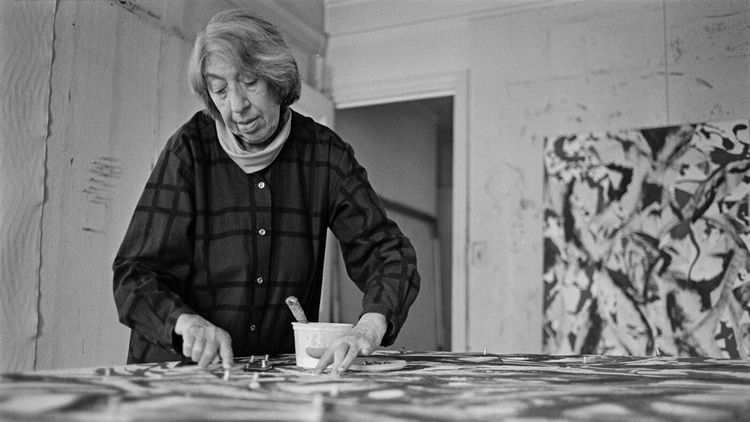
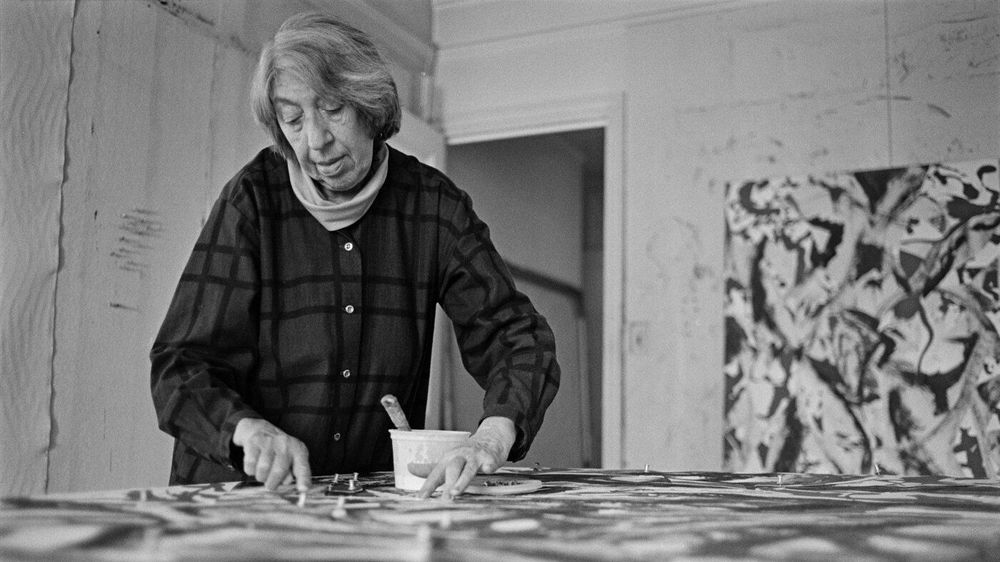
Lee Krasner Takes Center Stage at Met's Major Abstract Expressionism Exhibition
A groundbreaking exhibition at New York's Metropolitan Museum of Art is reshaping how the art world views one of Abstract Expressionism's most overlooked talents. Past Continuous, featuring 74 works by Lee Krasner alongside 48 by her husband Jackson Pollock, marks the first major New York presentation devoted to either artist in more than 20 years.
The exhibition challenges decades of art history that relegated Krasner to the margins as Pollock's wife and supporter, rather than recognizing her as a formidable Abstract Expressionist in her own right. Far from being merely a footnote to Pollock's fame, Krasner was already an established abstract artist before the couple met in 1942 at an exhibition organized by artist John Graham. In the 1930s and 1940s, she was well connected in the New York art scene and introduced Pollock to key figures including Willem de Kooning and critic Clement Greenberg.
One of the exhibition's most striking pieces is Krasner's 1955 collage Bald Eagle, a riotous composition of browns, blacks, fuchsia, and orange with a dramatic yellow slash. The work reveals Krasner's bold artistic choices during a pivotal moment in her career.
"Collage was very catalytic for her at these crucial moments in her life," said Brinda Kumar, one of the two Met curators who organized the exhibition. "She was literally sometimes tearing up older bodies of work to create a new chapter."
The collage incorporates fragments of Pollock's discarded drip paintings from the 1950s, transforming rejected material into something entirely new. "Krasner has very intentionally and deliberately cut up discarded Pollock works from this era in the 1950s, where you can see his distinctive drip still evident," Kumar explained.
A Career Built on Reinvention
Born Lena Krassner in Brooklyn to Orthodox Jewish parents from what is now Ukraine, Krasner reinvented herself multiple times throughout her life. She changed her name first to Lenore, then to Lee Krasner, and built a new identity as a bold artist despite having no family background in art.
From 1934 to 1943, Krasner worked for the Federal Art Project, during which time she studied with influential teacher Hans Hofmann, who exposed her to Pablo Picasso's use of form in Synthetic Cubism and Henri Matisse's use of color and outline. This formal training gave her a sophisticated artistic foundation that would inform her constantly evolving style.
"Krasner was so fascinating because she changed, not even by the decade. Every few years, she tries something new," said journalist Mary Gabriel, author of Ninth Street Women, a book exploring five female Abstract Expressionist painters. "She was always searching, which in a way is the most, I think, honest way to be an artist, because art is about discovery."
The couple married in October 1945 and purchased their Springs, Long Island home the following month with a $2,000 loan from gallerist Peggy Guggenheim. Krasner chose the remote fishing community specifically to distance Pollock from Manhattan's distractions and alcohol. The home, now a National Historic Landmark owned by Stony Brook University, preserves the barn studio where Pollock created his famous drip paintings. The floor still bears his paint splatters beneath Masonite baseball game boards he used to cover it in 1953.
While Pollock worked in the barn on his enormous canvases, Krasner painted first in the kitchen and later in a small upstairs bedroom. When asked in a 1978 interview what she was doing while Pollock was becoming famous, she replied simply: "I was working all the time. I doubt our relationship could have existed at all if I weren't working."
Strategic Business Acumen
Krasner understood the gender politics of the art world and made strategic decisions accordingly. After Pollock's death in a 1956 car crash, she demonstrated remarkable business savvy. The Met had acquired Pollock's Autumn Rhythm (Number 30) in 1957 from his estate for $20,000 plus a trade of another work. Krasner more than tripled that price when selling additional works, setting new market standards not just for Pollock but for modern artists generally.
For this exhibition, co-curator David Breslin said the museum moved Autumn Rhythm to a freestanding display. "It is almost architectural in a way, because it's set against this slate grey color," Kumar noted. "The swirling blacks get animated in a whole new way, and the familiar teals and the familiar whites surge with a new energy."
The juxtaposition of the artists' works reveals new dimensions in both. "That doesn't mean that the individual parts forgo their histories or their pasts," Breslin said. "We see that almost as a metaphor for couples in relationships as well. You form a unit, yet you also have all the things in your head, in your mind, in your heart that are your own, that don't change."
A Career Flourishes After Loss
After Pollock's death, Krasner took over his barn studio and created some of her most vibrant work. Her 1957 painting The Seasons, nearly 17 feet wide, features sprawling forms, eyes, body parts, and vegetation-like shapes bursting with life.
"She makes, almost in a contradictory way, some of the brightest, most vibrant paintings the year after his death," Breslin observed.
Recognition came slowly for Krasner. Her first major retrospective was held at the Whitney Museum of American Art in 1973, and in 1978 she was the only woman included in the major exhibition "Abstract Expressionism: The Formative Years" at Cornell University's Herbert F. Johnson Museum of Art. Following her death in 1984, critic Robert Hughes of Time magazine dubbed her the "Mother Courage of Abstract Expressionism" at her memorial service, held in the Medieval Sculpture Court at the Met.
Krasner's legacy extends beyond her artwork. The Pollock-Krasner Foundation, established in 1985, has awarded more than 5,200 grants totaling over $93 million in 80 countries over four decades. Current grants ranging up to $50,000 support painters, sculptors, and artists who work on paper worldwide.
The renewed attention to Krasner's work extends internationally. A companion exhibition of her 1960s work opened at Gagosian Paris on October 19, 2026, marking her first solo exhibition in France and coinciding with the Met show.
Krasner and Pollock: Past Continuous runs at the Metropolitan Museum of Art through January 31, 2027.