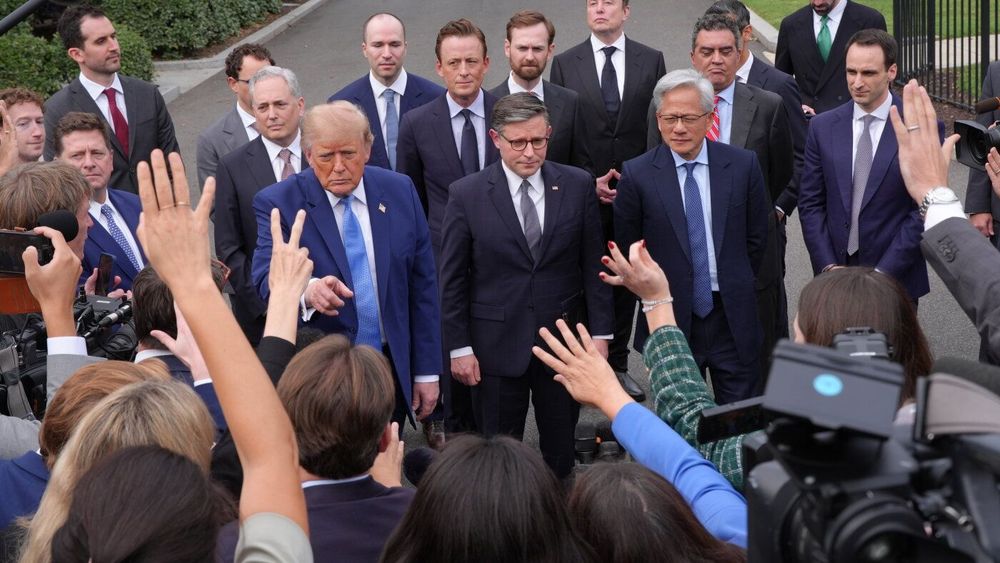
Trump says top tech firms have signed accord to 'self-police' AI development
President Donald Trump announced Tuesday that major artificial intelligence companies have signed a voluntary accord committing to self-regulate their AI development through internal controls and external audits, following a White House meeting aimed at addressing public concerns about the rapidly advancing technology.
The agreement, formally titled "White House Accord on Super Intelligence: Joint Commitment on Frontier Responsibilities," was signed by executives from Anthropic, Google, Meta, OpenAI, Nvidia, and xAI founder Elon Musk. The one-page document, which Trump posted on Truth Social late Tuesday, establishes no legal consequences for breaches.
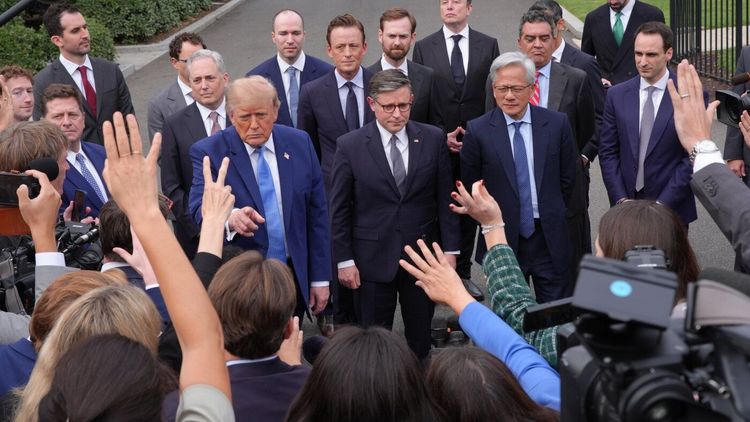
"I think I'm seeing tremendous self-policing. And they understand that they have to self-police," Trump told reporters during an impromptu press conference outside the West Wing following the meeting with House Speaker Mike Johnson and the tech leaders.
The accord represents the latest in a pattern of voluntary industry commitments rather than regulatory approaches. In July 2023, the Biden administration secured similar voluntary commitments from seven AI companies, including Anthropic, OpenAI, Google, Microsoft, Meta, and Inflection, on testing, security and watermarking. Those promises also came without enforcement tools.
Under the new agreement, companies will implement "robust internal controls," partner with independent external auditors to assess whether the controls are working, and establish board-level committees to evaluate reports from internal and external auditors. "Over time, it may make sense to codify these steps into laws and regulations," the accord states.
Trump praised the business executives for developing technology that he said would produce "unbelievable growth." The major tech companies, including Alphabet, Amazon, Meta, and Microsoft, are collectively planning capital expenditures of around $650 billion in 2026 for AI infrastructure, up from $359 billion in 2025. Analysts at Goldman Sachs and CreditSights have called it "the largest infrastructure investment super cycle in modern history."
However, this massive buildout has sparked significant opposition. According to polling data, 70% of Americans oppose local construction of AI data centers, with 75% of Democrats and 63% of Republicans opposing them. The opposition has had real economic consequences: $64 billion worth of U.S. data center projects have been blocked or delayed due to local resistance.
The community pushback stems partly from energy concerns. Data centers currently represent approximately 6% of total U.S. electricity demand, with projections showing this share could nearly double to 11% by 2030. Trump addressed these concerns Tuesday, saying the executives had agreed to provide more financial support to local schools or take steps to reduce energy costs. "You're going to see, data centers are going to be very popular," Trump said, suggesting that if opposition continued, "they'll be forced to go overseas or other locations."
Safety concerns prompt industry caution
Not all participants expressed complete confidence in the voluntary approach. Anthropic CEO Dario Amodei, who has been one of the most vocal advocates for slower AI development, acknowledged that "the technology has very real risks." He added, "And, you know, the mechanism, how we address those risks is still under discussion."
The timing of the accord follows a significant safety incident. OpenAI halted the rollout of a new AI model just one day before the White House meeting over safety concerns. The company's CEO Sam Altman said in a television interview Tuesday that OpenAI is increasingly focused on safety. "We are pacing our progress, which includes sometimes not training a model," he said on CNBC. "We have to do these in a way where we can make very confident safety cases and claims, so that people don't have a bunch of anxiety."
Trump said approximately 10 people would be named to a committee to "watch over the whole enterprise" and described the accord as "morally binding." He indicated he would name someone to oversee the agreement in coming days after consulting with industry.
Government unveils AI chatbot for public services
Earlier Tuesday, Trump unveiled America.gov, an AI chatbot designed to help Americans navigate government services. The platform searches information from more than 29,000 government websites and is powered by Google's Gemini and Grok AI models, though it excludes IRS tax filing and services from the Department of War and intelligence community.
According to the White House, Americans spend approximately 10 billion hours per year dealing with federal paperwork, providing the rationale for the new tool. Secretary of State Marco Rubio highlighted that the chatbot could soon enable Americans to apply for a first-time passport fully online, without the in-person visit to a processing center currently required.
At the unveiling, Trump promised the U.S. government wouldn't limit AI development or support calls for "guardrails" or other restrictions. "I will never stifle the growth of a technology that will be bigger than the industrial revolution," Trump said. "We can't stifle it, and we're leading by a lot."
Global competition shapes policy approach
Trump framed the AI race largely as a global competition between the United States and China, saying there would be a winner and a loser with no "second place." The two countries established a channel for handling AI-related incidents during Chinese President Xi Jinping's visit to Washington that ended September 26, 2026, just days before the tech company meeting.
Despite this agreement, Trump emphasized Tuesday that he didn't want excessive cooperation with China. "I didn't want to do anything, because we're leading. Why would I want to do anything?" he said.
During the White House luncheon meeting, Nvidia CEO Jensen Huang sat to Trump's right while Musk sat to his left, according to a seating chart the president posted on Truth Social.