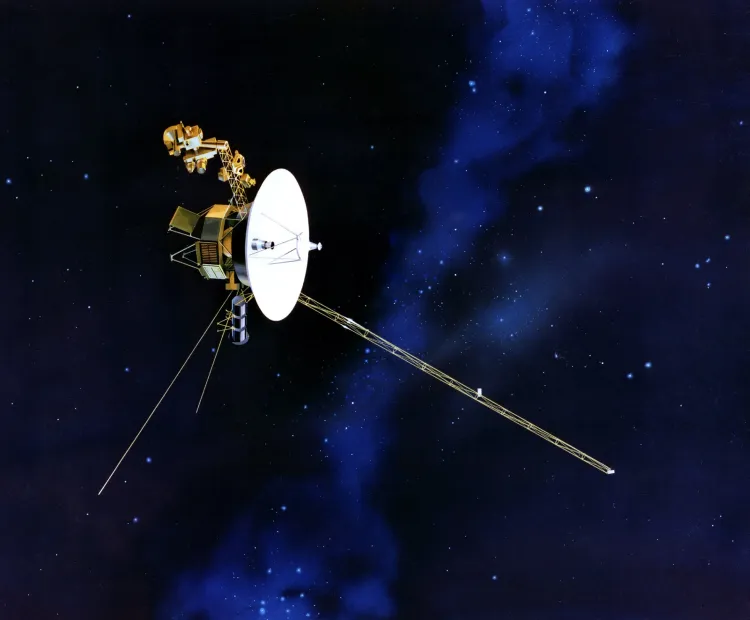
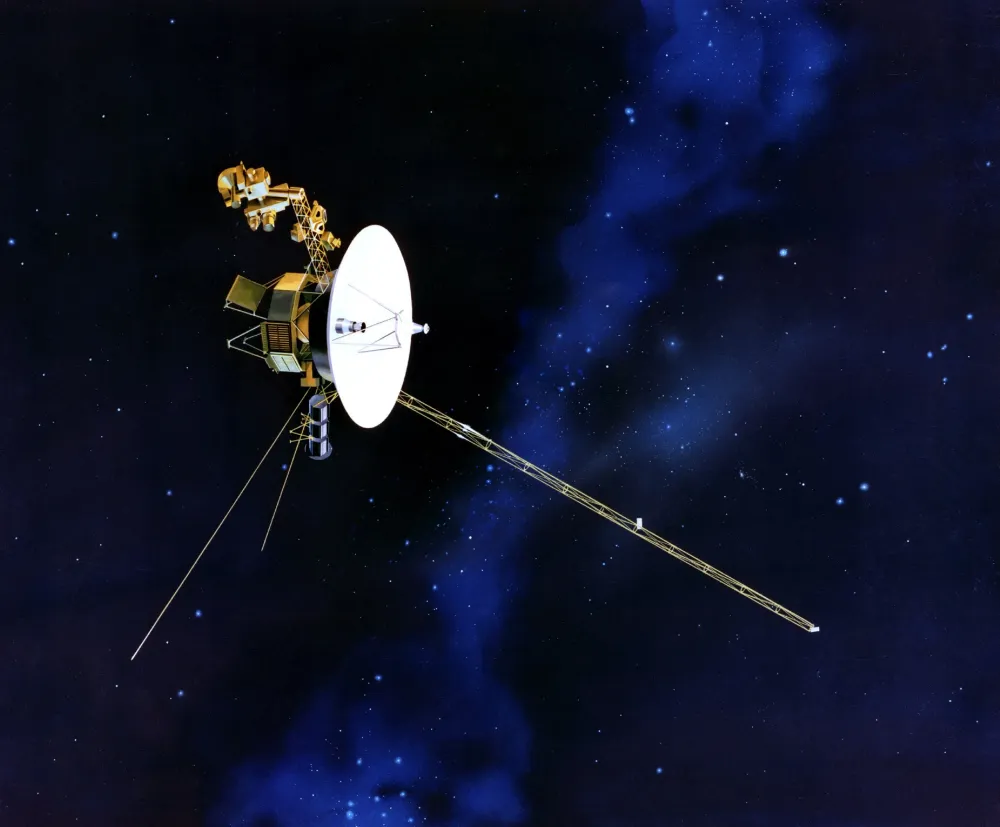
An automatic response far from Earth
NASA's Deep Space Network heard no signal from Voyager 1 during scheduled communications sessions on October 18 and 19. Its antennas, located at three facilities around the world, made those attempts 24 hours apart. Contact resumed another 24 hours later and has continued since, JPL reported in an October 29 release.
Launched in 1977, Voyager 1 is now about 16 billion miles from Earth. Engineers reviewing the interruption found that one thruster group had stopped operating and a backup group had activated. The spacecraft is programmed to make that change when its computers detect a problem with the thrusters in use.
The response is part of what JPL calls fault protection: the spacecraft suspends normal operations and settles into a safe, stable configuration while engineers work to identify the problem.
"This is the first time we've seen the spacecraft do something like this, but we are also at a point in the mission where we have to expect the unexpected," said Kareem Badaruddin, Voyager mission manager at JPL. "We're relieved to be back in contact with Voyager 1 and are eager to understand what happened," he said.
The mission had previously worked to restore a thruster backup. According to ShiftDelete.Net Global, JPL brought a set of Voyager 1 roll thrusters back into service in 2025 after they had been considered unusable since 2004. That work was intended to provide a backup if residue clogged the primary thruster set.
Power-saving work and instrument shutdowns
Before the October interruption, engineers completed a separate power-saving operation on Voyager 1 in early September. Known as the "Big Bang," it replaced three devices with three alternatives that use less electricity. All six help maintain operating temperatures, so the three replacements had to occur together to preserve the distribution of heat.
Voyager 2 underwent the same procedure about six weeks earlier. The Register had reported in April that NASA planned to test it on Voyager 2 in May and June 2026, then proceed with Voyager 1 no earlier than July if the test succeeded.
Both spacecraft rely on radioisotope thermoelectric generators, which convert heat from decaying plutonium into electricity. Each probe's available power falls by about 4 watts annually. NASA said that without the September swap, Voyager 1 would have needed to shut down another science instrument as early as summer 2027.
Voyager 1 began its mission with 10 dedicated science instruments. Power shortages have forced two shutdowns in recent years: the cosmic ray subsystem in February 2025 and the low-energy charged particles experiment, or LECP, in April 2026. By late 2026, only the magnetometer and plasma wave subsystem remained in operation, according to ShiftDelete.Net Global.
The LECP shutdown followed an unexpected drop in power during a planned roll maneuver on February 27, 2026, The Register reported. Engineers turned the experiment off on April 17 to avoid triggering the spacecraft's undervoltage fault protection. They kept its small, 0.5-watt motor running to preserve the possibility of restarting the instrument if additional power becomes available.
Approaching one light-day from Earth
Traveling at 38,000 mph, Voyager 1 is approaching a distance of 16.09 billion miles, or 25.89 billion kilometers, from Earth: one light-day. It is projected to reach that point on November 18, 2026, at 5:16:07 a.m. EST (10:16 UTC), according to ShiftDelete.Net Global.
At that distance, a radio command needs 24 hours to reach the spacecraft, with another 24 hours required for its reply to arrive at Earth.
"If you want to say 'hello' to Voyager, you send your message and then you go home and you wait two days before you finally get a response," said Suzanne Dodd, Voyager project manager at JPL.
No human-made object has traveled farther than Voyager 1, though crossing the one-light-day mark will not change anything aboard the probe. It and Voyager 2 remain the only spacecraft directly studying interstellar space, according to ShiftDelete.Net Global. That region lies beyond the heliosphere, the bubble of particles and magnetic fields produced by the Sun.