From Mountain Girl to Nashville Star
Dolly Parton, one of the most beloved entertainers in popular culture, has died at the age of 80. A country music singer, songwriter, actor and philanthropist, Parton's albums sold more than 100 million copies, and her influence extended far beyond the recording studio into film, business and charitable work that touched millions of lives.
Parton always presented herself as a humble yet audacious mountain dreamer made good. She built her identity on proudly claiming the Appalachian poverty and ingenuity she came from, growing up as one of 12 children in a rural hamlet nestled in the Smoky Mountains of East Tennessee.
In a 2002 NPR interview, Parton recalled her childhood without electricity in the early days. "I was thinking how far I've come from no electricity to now, to living in this high-tech world," she said. The family barely made it financially, but had things money couldn't buy. "We had a lot of stuff that money can't buy anyhow — things like love and kindness. And we had music. My mother's people were very musical. So that really got us through a lot of hard times."
Rise to Nashville Stardom
Parton began writing ballads and singing on local radio as a child. She moved to Nashville immediately after graduating high school in 1964, determined to make it in country music at a time when it was difficult for women to establish themselves as both singers and songwriters.
In 1967, veteran hitmaker Porter Wagoner asked her to join his TV show. She partnered with Wagoner for seven years, serving as his duet partner until 1974. Her wit and magnetism helped her transcend the limitations of being his girl singer, and she eventually moved on to focus on her solo career.
As Parton told NPR in 1989, she treated her songwriting as her greatest asset. "That's what I take more serious than anything else that I do in the business. It was my songwriting that got me out of the Smoky Mountains and that I feel that has taken me into all the places," she said. "To me, the guts and the root of the whole thing is the writing."
Record-Breaking Recognition
Parton earned dozens of Top 10 country hits during her career. She received 55 Grammy Award nominations, making her the third-most nominated woman in Grammy history, and won 11 competitive awards. She also received the Grammy Lifetime Achievement Award in 2011.
Her honors extended beyond music industry accolades. In 1999, Parton was inducted into the Country Music Hall of Fame. In 2005, she received the National Medal of Arts, the highest award given to artists by the U.S. government, followed by the Kennedy Center Honors in 2006. In 2022, she was inducted into the Rock & Roll Hall of Fame, initially hesitating because she didn't feel she had "earned that right" as a rock artist before ultimately accepting the honor.
One of her most enduring compositions, "I Will Always Love You," reached new heights when Whitney Houston recorded it in 1992. Houston's cover became one of the most successful singles in pop music history, bringing Parton's songwriting to an even wider global audience.
Hollywood and Beyond
Parton's professional ambitions grew along with her career. She insisted she was not leaving her country roots behind, but bringing them with her as she crossed over into pop stardom and moviemaking in the late 1970s and early '80s. She gave memorable performances in "9 To 5," "The Best Little Whorehouse in Texas" and "Steel Magnolias," alongside celebrated actors like Jane Fonda, Lily Tomlin, Julia Roberts and Sally Field.
In 1986, Parton opened Dollywood, her own theme park in Pigeon Forge, Tennessee. The park, which opened on May 3, 1986, is co-owned by Dolly Parton and Herschend Family Entertainment, with each holding a 50% ownership stake. Dollywood has been named Tennessee's number one ticketed tourist attraction for over a decade and was named TripAdvisor's top theme park in the United States in 2025, 2024, and 2022.
A Legacy of Giving
Beyond entertainment, Parton dedicated herself to philanthropy. In 1995, she launched the Imagination Library, a program that has gifted more than 300 million free books to children from birth to age five in the United States, Canada, the United Kingdom, Australia and the Republic of Ireland.
In April 2020, during the COVID-19 pandemic, Parton donated $1 million to coronavirus research at Vanderbilt University Medical Center. Her contribution helped fund critical early research connected to Moderna's COVID-19 vaccine, demonstrating her commitment to causes beyond the entertainment world.
The Dolly Persona
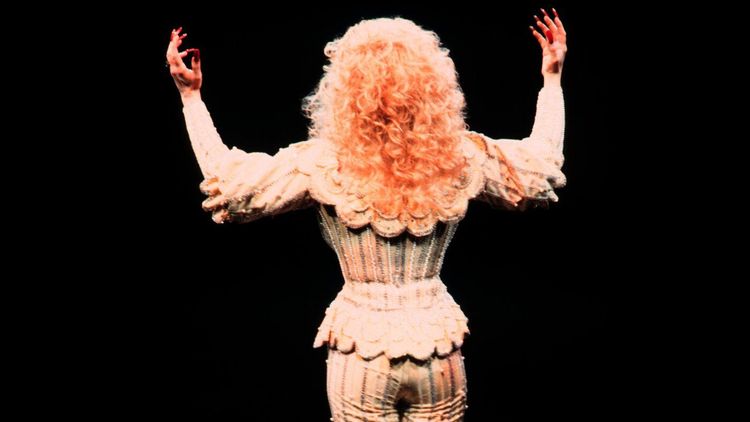
Parton cultivated an over-the-top hyper-feminine look for years — piled-high blond wigs, stiletto heels and tight-fitting costumes that she modeled after a woman from back home. In a 2014 NPR interview, she explained: "It's true I look totally artificial, but I like to think I'm totally real where it really counts. But my look came from a very sincere place. It's just a country girl's idea of glamour."
In front of audiences, Parton made endless self-aware jokes about her exaggerated appearance, which made her a role model for drag queens. Drag performer Trixie Mattel observed: "Dolly put on a Dolly costume every day. Dolly played Dolly onstage. Dolly played Dolly in the musical of 'Dolly' in real life."
Parton's performances made people of all cultures, identities and ideologies feel like she was theirs to claim. As Mattel noted, "It's the one thing maybe a hardcore conservative and a drag queen can have middle ground on."
Throughout her later years, Parton frequently returned to songs and sounds associated with her mountain youth. New generations embraced her celebrity, whether or not they paid attention to country music. She cannily avoided wading into divisive issues while maintaining her universal appeal.
Of all that Dolly Parton created during her lifetime, her greatest work of art was the indelible image she fashioned for herself — backwoods brilliance dressed up in showbiz splash, a persona that transcended entertainment to become an American cultural icon.