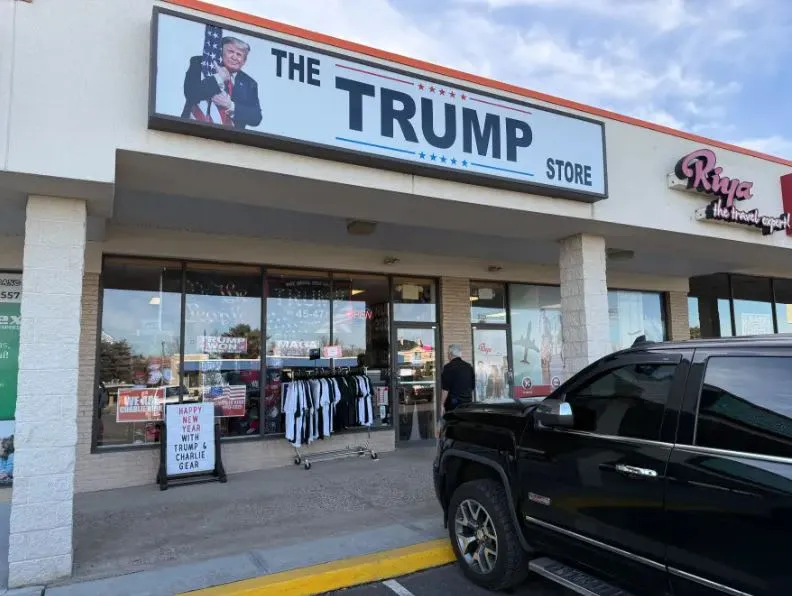
Store closures and clearance sales
About 20 specialized Trump stores remain in business, according to Vocal Media, but many are reducing inventory and changing their layouts as demand weakens. MAGA Mall, an online retailer and wholesaler, reports overall sales running 30% below those of a presidential election year with Trump on the ballot.
Bill Hays closed his Knoxville, Tennessee, superstore in September. After opening in April 2024, the store had reached monthly sales of $200,000 and drawn lines of 80 customers outside. By its closing, monthly revenue was down to $20,000.
In Myrtle Beach, South Carolina, Trump Super Store co-owner Rick Kligman is offering $40 grab bags for $9.99 to move older stock. He told Fortune in an October 2026 report that sales of Trump-branded goods were 39% below their 2024 levels and that he wants to leave the business by the end of 2027.
Sany Dash has already closed all three of her USA Trump Stores: locations in Gainesville and Arlington, Texas, and Loveland, Colorado. Dash told Fortune that falling revenue forced the closures in 2026, despite what she described as $63 million in Trump merchandise sales over nine years. She now plans to concentrate on patriotic jewelry and clothing sold at rallies.
A smaller market for retailers and suppliers
The election-year market provides a measure of the business sellers once enjoyed. Fortune cited e-commerce marketing platform Omnisend's estimate that Amazon sellers reported $140 million in Trump-themed merchandise sales between April and September 2024 as a baseline for the subsequent decline.
Manufacturers are also seeing fewer orders. Eric Turney, sales director at custom product manufacturer The Monterey Company, told Fortune that the company earned about $250,000 in 2024 producing MAGA hats, keychains and buttons for nine wholesalers. Only three remain regular customers for those products. Orders averaged 15 a month in 2024; across 2025 and 2026, the total was just 13.
Online interest has weakened as well. Google Trends data cited by Fortune showed searches for "MAGA hat" down 95% as of October 2026, following peaks in December 2018 and November 2024.
The slowdown is not universal. Seth Hansen, owner of the Trump Store Branson in Missouri, told The Wall Street Journal that sales were below 2024 levels but that his stores were thriving. His Trump store generated seven-figure revenue in 2025, he said. Hansen attributed competitors' difficulties to a lack of business sense.
Less campaign urgency, more political discontent
Retailers are selling without the election campaign that previously gave supporters an immediate reason to buy. Trump is serving his second and final term, and one observer described supporters as having "felt their job was done" after the inauguration.
"He has peaked," said Wes Alker, a retired mechanic and devoted supporter who attended a going-out-of-business sale at a store in suburban Philadelphia. "He's no longer a viable business model."
Some sellers also point to dissatisfaction with Trump's policies, including deep staffing cuts under the Department of Government Efficiency. Hays described a change in customers' willingness to display their support: "People were not wearing their colors, so to speak, like they did before the election." Retailers have also expressed concern that a Democratic sweep of Congress in the midterms could weaken demand further.
A Fox News poll released October 14, 2026, found that 77% of registered voters disapproved of Trump's handling of inflation, while 70% disapproved of his handling of the economy. His overall approval stood at 36%, the lowest Fox News had recorded across his two presidencies.
Donald "Whitey" Taylor, who operates Trump Town USA in a former church in Boones Mill, Virginia, attributed his store's decline to high gas prices and persistent inflation. He told The Wall Street Journal that daily revenue had fallen from more than $15,000 at its 2024 peak to an average of about $1,500.
Liz Hall, an independent sales representative in Syracuse, New York, sells nearly two dozen product lines, including Trump merchandise. She told the Journal that Trump apparel sales started falling after his 2024 re-election and "took a nosedive" after the U.S. attack on Iran at the end of February 2026.
Customers are less eager to display their purchases
The change extends beyond how much shoppers spend. Customers who still buy merchandise often request a bag instead of putting it on before leaving the store. Displays that once generated impulse purchases increasingly attract people who browse without buying.
Committed supporters continue to shop, but many casual customers who once bought a hat or T-shirt after a rally or during a holiday weekend have pulled back. The customer base is narrowing toward the brand's core supporters rather than retaining its earlier appeal across generations.
That leaves merchants with a business unusually tied to one political figure. Presidents from Ronald Reagan to Barack Obama inspired devoted followings, but neither produced a comparable national network of dedicated stores. Hays credited Trump's appeal to his being "a salesman and he tells people what they want to hear."
Broader products and decisions ahead
Stores are adding products built around "We the People," American pride, religion and conservative themes rather than Trump alone. MAGA Mall president Ron Solomon said the merchandise business "will fade away" after Trump leaves the national stage unless a family member carries the brand forward.
Some Trump products still find renewed demand. The Trump Organization introduced $50 "Trump 2028" hats in April 2025, and Solomon told Fortune that the line attracted fresh interest at Republican midterm rallies in 2026.
For other sellers, the immediate task is deciding how much longer to stay open. Kligman has been trying to clear older merchandise before the midterms. Hays is waiting to assess Christmas sales at his Gatlinburg, Tennessee, location before deciding its future.