Better yields lift the estimate
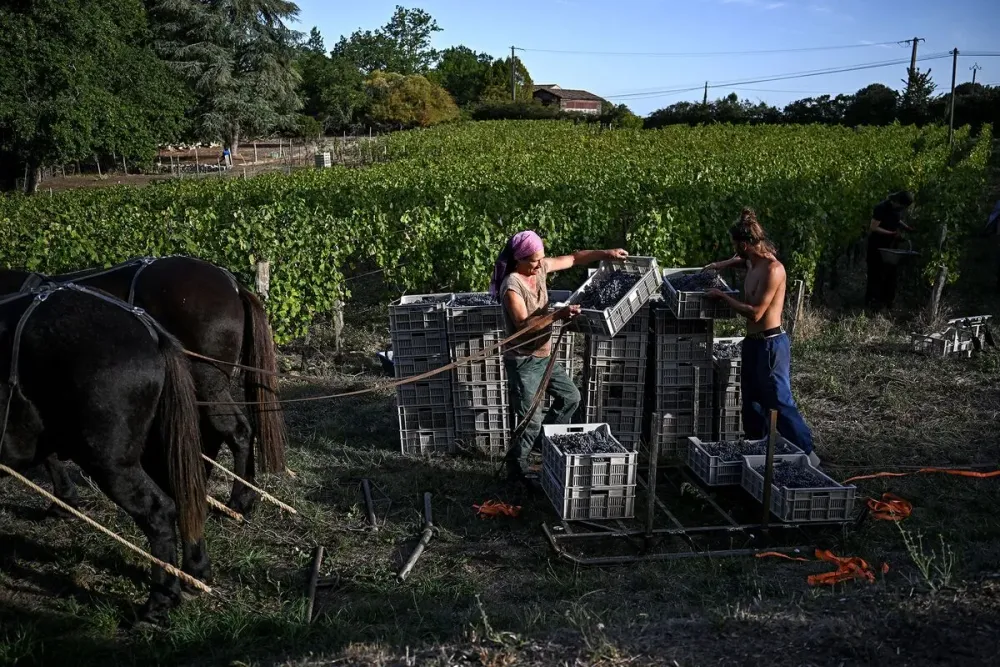
The agriculture ministry's November 6 report, based on initial harvest declarations, puts production above the 35 million hectoliters forecast in October. The revised total would be 3% higher than in 2025, though still 10% short of the five-year average.
According to Reuters, the ministry's Agreste report attributed most of the revision to yields exceeding expectations in Languedoc-Roussillon and Charentes, regions that together account for about half of France's wine output. Champagne and the South-East also delivered better yields than forecast.
Languedoc-Roussillon leads an uneven harvest
The regional outlook varies sharply. Rain late in the summer limited drought damage in Languedoc-Roussillon, where production was forecast to rise 25% from a very weak 2025 harvest. Wine Makers Show's analysis of Agreste data put the region's share of French wine at roughly 30% in 2026, up from about a quarter a year earlier. Without that region, production across the rest of France was down around 9%.
Bordeaux was expected to produce 10% more wine than in 2025, but its forecast remained 11% below the five-year average, in part because vineyards have been removed.
Champagne's better-than-expected yields did not erase the damage from frost, hail, drought and summer heat waves: the ministry still forecast a 38% decline from 2025. Burgundy-Beaujolais faced a 22% drop, while the Loire's output was projected to fall 7%.
Fewer vines as demand weakens
Alongside weather-related losses, France is deliberately reducing vineyard acreage in response to falling consumption. FranceAgriMer said a second program for permanent vine removal received 5,923 applications covering 27,926 hectares. Those applications included 1,392 winegrowers seeking to stop production altogether, representing 10,342 hectares. The program follows a €120 million measure aimed at reducing wine production capacity during the 2024-25 campaign.
The Agriculture Ministry also reported a contraction in wine and spirits exports. It attributed the decline to weaker consumption in major markets, including the US, Canada, China and Japan, as well as higher tariffs in some importing countries and currency volatility. Those pressures have continued to push down producer prices for appellation wines, the ministry said.
Champagne has set its permitted yield for the 2026 harvest at 8,800 kg per hectare, equivalent to approximately 250 million bottles. This is its fourth consecutive reduction and the lowest limit in the modern era except for the COVID-affected 2020 harvest.
Summer damage and farm support
The Agriculture Ministry reported a national average temperature of 24.9°C in July 2026, exceeding the previous records it cited for 2003 and 1976. It described drought across 65% of France as "unprecedented drought". At summer's peak, 95 departments had water restrictions, and 79 were classified as being in "crisis".
On September 4, 2026, Agriculture Minister Annie Genevard announced more than €1 billion in support to compensate farmers for losses and help agricultural production recover. The package included an estimated €520 million from the national solidarity compensation scheme, more than €300 million in property tax relief for undeveloped land, and €30 million under the agricultural disaster scheme for uninsurable losses, including vine damage. A further €235 million agricultural recovery fund was also established.