New space in the Ion District
The Ion District in Midtown brings entrepreneurs, investors, corporate teams and academics into a shared innovation hub. Its next addition, the Arc, will stand seven stories tall and contain nearly 200,000 square feet of research, corporate innovation and office space next to the Ion.
Rice announced the November 4 groundbreaking on October 29, 2026. The university will be the building's lead tenant, taking nearly 80,000 square feet.
Also in the district, Greentown Labs Houston has helped more than 320 startups since it opened in 2021. According to Greentown Labs, its approximately 30,000-square-foot Houston incubator currently houses more than 100 startups focused on industrial decarbonization and clean power.
Fervo reaches commercial operation in Utah
Houston-based Fervo Energy offers an example of the connection between the city's established energy expertise and emerging technologies. The company uses advanced drilling technology to produce geothermal energy.
On October 1, 2026, Fervo announced that its first Cape Station power plant in Beaver County, Utah, had entered commercial operation. The company described it as the world's first greenfield enhanced geothermal development to achieve contractual commercial operations.
The first GeoBlock produced 33 MW of net power. Phase I consists of three 33-MW GeoBlocks, totaling about 100 MW; the other two are expected to reach contractual commercial operation by January 1, 2027.
Construction is already underway on Phase II, which would add 400 MW and is expected to begin commercial operation in 2028. Fervo says its portfolio has more than 1 gigawatt covered by signed, binding power purchase agreements.
Industry expertise and international connections
Houston's business base extends across energy, healthcare, aerospace, advanced manufacturing and logistics, with established companies operating alongside startups. Medical research, biotechnology and healthcare innovation are centered at the Texas Medical Center, while NASA's Johnson Space Center advances aerospace exploration. Energy companies are also pursuing hydrogen and carbon management technologies.
These industries' proximity creates opportunities for work across disciplines. Houston's international business ties and multicultural workforce add perspectives from around the world; the city is among the nation's most diverse major cities.
For business visitors, that international character extends beyond meetings into Houston's restaurants, arts venues and neighborhoods. Technology meetings and research visits sit alongside cultural experiences and cuisines reflecting the city's global connections.
A convention district expansion through 2038
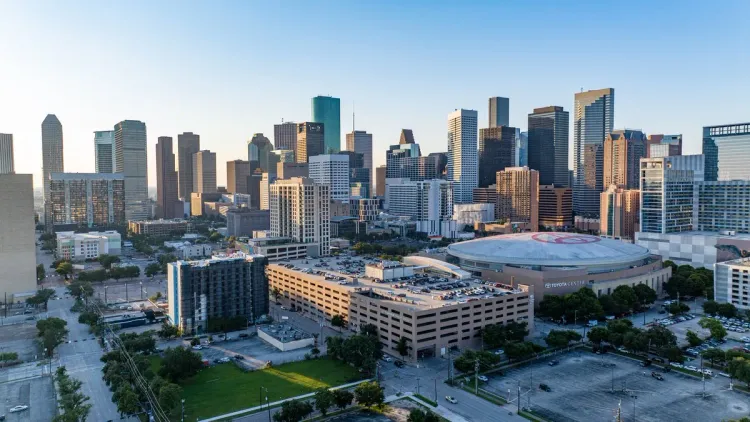
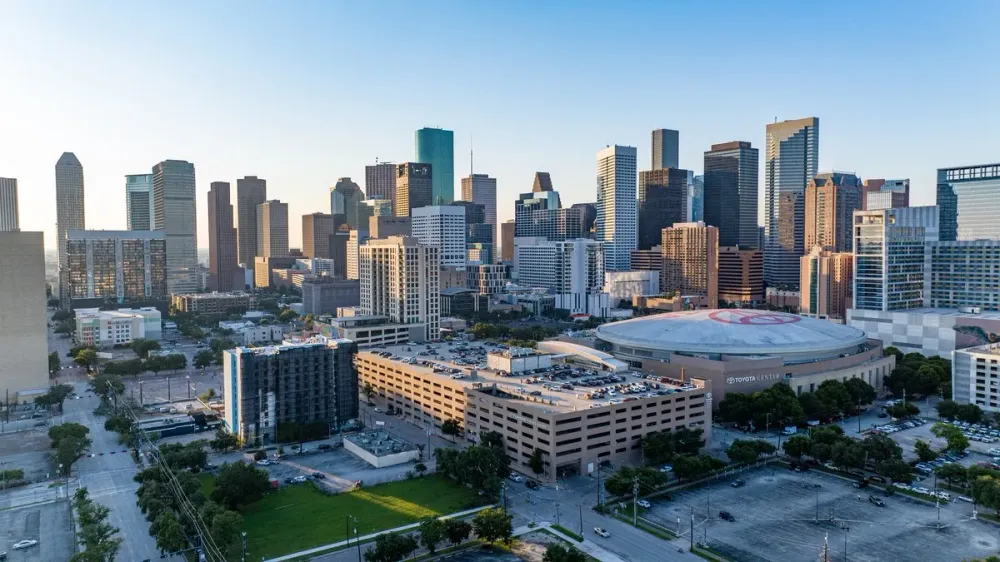
Downtown's George R. Brown Convention Center, or GRB, provides an established gathering place for industry conferences and exhibitions. Houston First says it now accommodates more than 250 events and meetings a year, including over 30 major conventions.
The center opened in 1987 with more than 1.1 million square feet. An 800,000-square-foot addition in 2003 nearly doubled its size, and a 2016 renovation connected the building more closely to Discovery Green and created Avenida Houston Plaza. The current 1.8-million-square-foot facility arranges exhibition, meeting, registration and event spaces on multiple levels.
GRB Houston South is expected to open in May 2028 as part of a broader campus transformation scheduled to proceed in phases through 2038. The project will carry the pedestrian-friendly Avenida area southward, adding connections among Discovery Green, the convention center and downtown's eastern edge.
Plans call for a 700,000-square-foot building with two exhibition halls totaling 150,000 square feet, a multipurpose hall of 50,000 square feet that opens onto a new Central Plaza, and an atrium flex hall of 25,000 square feet. The plans also specify 225,000 square feet of contiguous exhibit space.
A ballroom ranging from 60,000 to 80,000 square feet is billed as the largest in Texas. A separate 100,000-square-foot pedestrian plaza will provide a link to the Toyota Center.
Tax funding and projected economic activity
The expansion's funding comes through Texas Senate Bill 1057, authored by then-Senator John Whitmire and signed into law in 2023. For 30 years, the law directs the state's share of incremental Hotel Occupancy Tax revenue growth within three miles of the GRB toward the project. That funding is estimated at nearly $2 billion.
Houston First says the arrangement imposes no burden on local taxpayers and resembles funding mechanisms used for convention center improvements in Dallas and Fort Worth.
An independent Hunden Partners study cited by Houston First forecasts more than $20 billion in additional spending and $6 billion in new payroll over 30 years from the GRB South building alone.
The study anticipates approximately 340,000 additional visitors each year and, once activity stabilizes, more than 337,000 additional group hotel room nights annually in downtown Houston. It also projects that the GRB will host 30% more events overall, with citywide meetings increasing by 62%.