Acknowledging the military's record
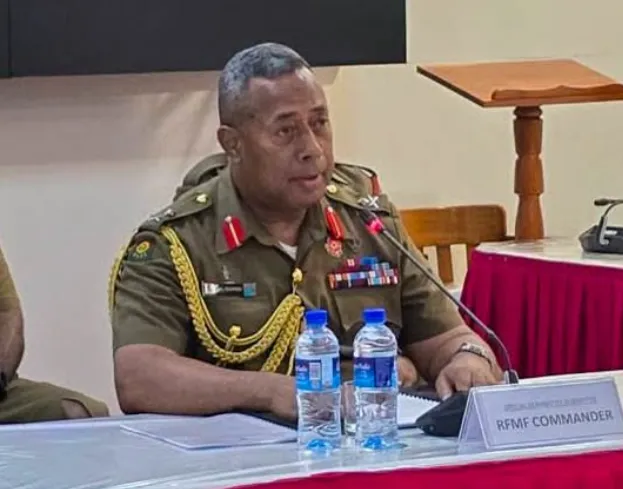
Commander Major General Ro Jone Kalouniwai addressed the Special Parliamentary Committee considering the Constitution (Amendment) Bill No. 32 of 2026. He acknowledged the Republic of Fiji Military Forces' central role in the coups of 1987, 2000 and 2006, saying the damage they caused remained unhealed.
Kalouniwai said the RFMF did not approach the committee with clean hands. He described an "architecture of rebellion" in which military overthrows were followed by changes to the law that legitimized unlawful acts. He identified secrecy, rule through fear, loyalty to one another and unity embedded in the Constitution as four pillars sustaining that cycle.
"This systemic impunity turned sacred words like stability, mercy, peace, and reconciliation into tools used to silence those who were wrong," he said.
A proposal to replace immunity
Fiji Sun reported that the RFMF's October 31, 2026 submission asked Parliament to delete Chapter 14 and said the force did not want the immunity granted by Section 206. It also accepted, without conditions, the civilian authority established in Section 151. Kalouniwai said the military had formally announced that position on October 16.
In place of Chapter 14's immunity provisions, the military proposed a Truth, Accountability and Reconciliation Commission. Any protection offered through that process would depend on full disclosure, and the gravest crimes would be excluded.
Kalouniwai warned that Section 207 of the proposed bill would have the opposite effect: after the bill's third reading, immunity would become permanent and beyond the courts' reach for future generations.
Limits on military power and election pledges
The RFMF recommended writing a duty into the Constitution for soldiers to reject manifestly unlawful orders. It also sought parliamentary oversight when the military is deployed internally.
Its proposed voting safeguards included preventing an early start to the election process and making any extension of Parliament's term subject to a two-thirds parliamentary vote.
For the proposed referendum and the next general election, the force pledged strict neutrality. It said soldiers would not campaign in uniform and promised to respect the outcome, whatever it might be.
FBC News reported that the submission supported retaining key constitutional provisions, including civilian oversight of the military, and restoring the Ombudsman. The RFMF also called for stronger protections for voting rights and human rights, the judiciary, anti-corruption institutions, children and persons with disabilities.
Reconciliation and Parliament's response
The RFMF cited reconciliation work dating to 2022. It acknowledged past wrongs in March 2024 and, in August 2025, presented a matanigasau, or traditional apology, to affected families, the Church and the Great Council of Chiefs.
Prime Minister Sitiveni Rabuka thanked the military leadership for presenting its submission live. He described the hearing as a vital opportunity for Fiji's legislature to hear from the people and construct a constitution.