
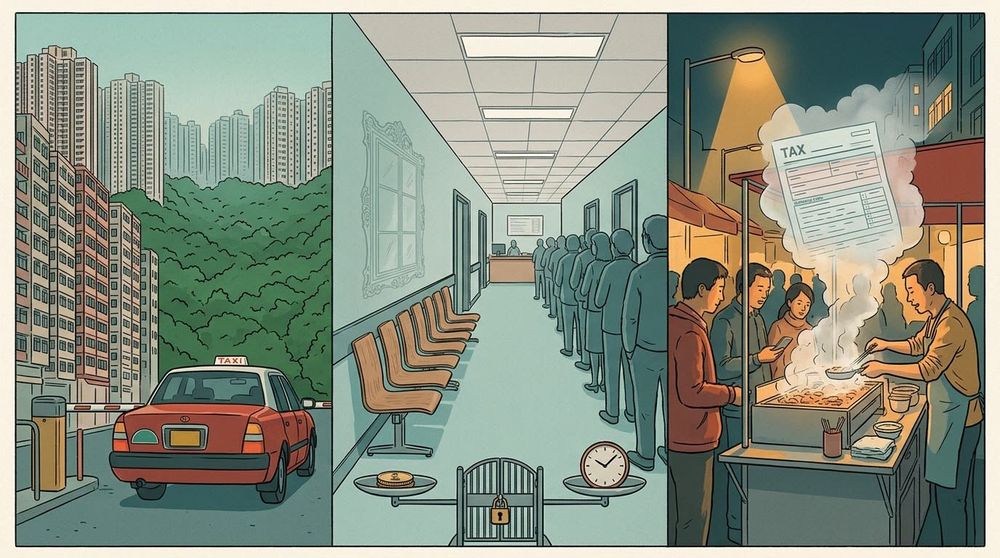
Hong Kong's tax rates tell only part of the story
Hong Kong combines relatively low taxes with extensive controls over access to land, occupations and public healthcare. Its standard profits tax rate is 16.5%, and its top salaries tax rate is 17%. There is no VAT, capital gains tax or inheritance tax. Those figures describe the tax burden, but not the full reach of government.
Land policy shows the distinction. Residential uses account for just 7% of the territory, compared with about 24% for developed urban land overall. Nearly 37% consists of country parks and special areas protected against development by the Country Parks Ordinance. Annual additions to residential land averaged 53,700 square meters between 2003 and 2010.
Revenue from land premiums has long been important to the government. Restricted land supply and low income taxes therefore belong to the same fiscal arrangement, rather than representing contradictory policies.
The government has also outlined a larger future supply. In October 2024, the Development Bureau estimated that about 3,000 hectares of spade-ready land would become available over the decade from 2025-26 through 2034-35, averaging roughly 300 hectares annually. About 60% of that new supply was expected to come from the Northern Metropolis. This is a projection for spade-ready land, distinct from the historical residential-land figures.
Other entry restrictions have lasted decades. Hong Kong has issued essentially no new hawker licenses since the 1970s; licensed hawker numbers declined from roughly 20,000 in the 1980s to about 5,300 in 2023. Medical education is concentrated in two universities. Although the University Grants Committee-funded medical intake increased from 250 in 2008/09 to 590 in 2022/23, median waits for stable new specialist cases were 66 weeks for ophthalmology, 49 weeks for internal medicine and 45 weeks for orthopedics.
Taxi licenses retain their restrictions as values fall
Hong Kong's taxi system separates the security of existing license holders from the opportunities available to newcomers. The number of taxi licenses has remained frozen at about 18,163 since the 1990s. Holders have permanent, transferable licenses, while drivers pay vehicle rent to license owners.
Scarcity has not insulated those assets from market changes. A Legislative Council Secretariat information note published May 15, 2025, reported that urban taxi license values had dropped as much as 57% over ten years, reaching HK$2.85 million at the end of 2024. By the end of April 2025, their value had fallen further to HK$2.4 million.
Average daily taxi patronage declined 29% from 2015 to 2024. The note attributed the deterioration to competition from platform-based ride-hailing, which expanded from 2015, alongside corrections in the local asset market.
The government has pursued service reforms within the conventional taxi system. In July 2024, it issued five taxi fleet licenses covering more than 3,500 taxis, or at least 19% of the territory's total. A separate driver offense-points system began in September 2024: every 15 points accumulated can result in disqualification from driving taxis for up to six months. Both measures were described in the Secretariat's May 2025 note.
The NHS rations access through referrals and waiting
Britain's NHS presents a different arrangement: care is tax-funded and state-provided, with general practitioners controlling referrals into specialist treatment. In this public-monopoly model, access is governed not simply by eligibility for free care but also by referral decisions and time spent waiting.
The British Medical Association's analysis of NHS England data, updated October 8, 2026, put the August elective waiting list at 7.37 million cases involving approximately 6.24 million individual patients. Around 2.56 million patients had waited more than 18 weeks, including about 113,000 who had waited longer than a year.
The median wait to begin treatment was 12.2 weeks, compared with eight weeks in August 2019, before COVID-19. The government has pledged to restore the constitutional standard of 92% within 18 weeks by March 2029.
The published list does not capture every obstacle. In 2024, when the elective list exceeded 7 million, a Healthwatch-commissioned YouGov survey found that about 14% of GP referrals never reached a hospital waiting list. Three-quarters of the patients caught in that referral gap reported worsening health.
Underinvestment and an aging population contribute to the pressure, but the system's structure also matters. Tax funding, restrictions on private alternatives and GPs' control over referrals make waiting a means of rationing demand. Patients able to pay can seek private treatment; others depend on the public queue and on their referrals reaching it.
Britain has a much older example of government rules shaping everyday choices. The window tax, introduced in 1696 and abolished in 1851, prompted people to brick up windows. NHS rationing operates through a different mechanism—not a tax on household features, but public control over access to care and its timing.
China's informal economy trades low taxes for uncertainty
For many small businesses and informal workers in mainland China, the immediate tax burden is low. Small-scale VAT taxpayers with monthly sales below 100,000 yuan are exempt through 2027. Individual industrial and commercial households receive a 50% reduction in individual income tax on business income up to 2 million yuan, as well as a halving of the "six taxes and two fees."
Street vendors, night-market operators, small shops, day laborers, delivery riders and ride-hailing drivers also often fall beyond effective tax administration. Authorities cannot readily identify all of them or track their earnings. Many consequently pay little or no tax and face low compliance costs.
That situation is not equivalent to a dependable, universally available low-tax regime. Treatment varies by city, period and enforcement campaign. Street vending has alternated between repression and selective tolerance, with activity moving between formal and informal spaces. Permission to operate today offers no assurance that a stall can remain tomorrow.
Protection can be similarly uncertain. Many vendors and flexible workers have limited access to health, pension and work-injury coverage. A roadside stall operator may owe no VAT yet lack employer-funded social insurance, paid sick leave or a secure right to occupy the site.
There have been efforts to extend coverage. Caixin Global reported on August 22, 2025, that a gig-worker social insurance pilot launched in 2022, initially covering workplace injury, had enrolled more than 12 million workers by 2025. The report said the State Council aimed to broaden protections nationwide by 2026; that was a stated goal, not confirmation of completed nationwide coverage.
Employers also announced changes. Beginning in March 2025, JD.com paid full social insurance—five categories plus a housing fund—for all its full-time delivery riders. It reported 150,000 such riders by mid-2025. Meituan announced nationwide pension subsidies in July 2025.
The informal sector's experience should not be generalized to registered companies. Formal businesses must deal with VAT, corporate income tax, social insurance and compliance requirements. Claims that mainland taxes are either light or heavy can reflect these different sectors without describing the economy as a whole.
Tax burden, access and predictability are separate questions
These comparisons require three distinct measures: how much the government collects, how difficult it is to enter an activity or obtain a service, and how reliably the rules apply over time. A favorable result on one measure does not establish the other two.
Hong Kong's low fiscal extraction coexists with substantial barriers in land development, medical practice, optometry, taxi operation and hawking. Rules can be relatively predictable for established participants while excluding newcomers. A transferable taxi license makes that distinction especially clear.
Britain combines high fiscal extraction with public-monopoly access to healthcare and substantial waiting costs. Free treatment describes how care is financed; it does not promise immediate treatment or eliminate referral gaps. Mainland China's informal sector offers low taxes and relatively easy entry, but weaker protection and less certainty about continued permission to operate.
For a prospective taxi driver, the constraint is obtaining a license. For an NHS patient, it may be a referral that fails to reach the waiting list. For a street vendor, it may be losing tomorrow's trading location despite paying little tax today. Each faces a different institutional barrier that a single label such as "low-tax" or "free" leaves unexplained.